Nothing is written in a void. When Nakae Choumin penned his 1887 masterwork, "A Discourse by Three Drunkards on Government" (三酔人経綸問答
Sansuijin Keirin Mondo lit. "Three Drunkards Governing Dialogue") an undercurrent of civil enlightenment was sweeping through the national polity of Japan. The words "freedom" "peace" and "constitution" were being drilled into the minds of the public. Rural farmers and Tokyo scholars alike were holding meetings in townhouses and huts to draft constitutions, read and discuss books, and engage in learning (Gordon 81). Choumin's great dialogical work captured the political arguments of the 1880s. Roughly divided into three arguments regarding western ideals of democracy and the equality of man, far eastern Samurai traditions and native Japanese identity, and a mediatory criticism of both, the novel has been applied as a universal narrative to countries around the world in vastly different time periods. It is also one of the most widely read of Choumin's books, treated in Japanese schools much as Rousseau and Kant are in American ones. And just as Choumin's work was the culmination of the political dialogue of the period, Okada Kouji and Kaneko Kazuma's 1992 video game
Shin Megami Tensei (lit. "True Transmigration of the Goddess") produced over a hundred years later, was the product of a much smaller-scale dialogue in digital media over the ideals of mass safety secured by a higher power at the expense of personal freedom, in conflict with the pursuit of heroism and individuality in exchange for a lawless rule by arbitrary strength.
Shin Megami Tensei is almost certainly not Okada and Kaneko's masterwork, but is a definitive turning point in their careers, and in an effort to reign in the ideas of the preceding
Megami Tensei series it drew considerable license from Choumin's writing to frame the newly-defined alignments of Law, Chaos and Neutral.
Shin Megami Tensei is the mature form of
Megami Tensei II. Where MT was biased towards Chaos and had definitive good and bad endings, in SMT there is no happy conclusion and the ideals are balanced with respect to their shortcomings in comparison to one another. This balance is tied inexorably to the format of Choumin's Discourse and the influence SMT's writers took from it. My efforts are to elucidate the origins of SMT's ideas, as well as to discuss at length the primary authors' shared passion for myth and politics.
Shin Megami Tensei is a game created by and for the culture of 1992 Japan. It is from a time spent in the aftermath of the crashing bubble economy, fenced by the political tensions surrounding American bases and shadowed by emerging new religious movements. It is from a world that did not have the '95 sarin gas attacks that was living below the trophy case of the high-growth era, when Japan was at its economic nadir and simultaneous peak political period. When
Shin Megami Tensei came out, Japan had a one-party government; by the time
Shin Megami Tensei II came out, that 38-year system had folded and a new, politically ambiguous administration had emerged. This is evident throughout the content of the Super Famicom duology.
In this Let's Play I will be periodically including citations to further reading on particular topics, mainly those relevant to Japanese history, but also to relevant literature.
Shin Megami Tensei is a surprisingly literary game, if you know how to trace the influence. This will not just be one of my mechanics-heavy breaking-the-game-over-my-knee LPs. This is a tenuous form of academic experiment for me. I will also be exploring the differences in translation between Aeon Genesis and Atlus USA's translation, based on my familiarity with AE's 2002 patch. I want to discuss the cultural influences SMT is drawing from, which have generally been lost in translation, and to place the game in the historical context of modern Japan. As someone who's working on an Asian Studies degree focused on this country, and as a student of Japanese art history, I'm excited to have the opportunity to go into this headfirst with everything I have. Atlus' translation is also subject to censorship to accommodate the iOS platform, which I'll be addressing where it arises.
As a caution going in,
I will not be expressly going for the Neutral ending. Virtually every online playthrough of
Shin Megami Tensei defaults to the Neutral alignment on the basis of it being either the most reasonable decision or the canonical ending. While it is true that the sequels mostly take place in worlds where the Neutral ending is presumed, the alternative Law and Chaos endings are still valid alignments. I will be reasoning out each alignment choice as we come to it and make my decision based on an ethical evaluation of the options, not necessarily with a specific long-term alignment in mind. I do have a pretty good idea of how I think
Shin Megami Tensei is going to evaluate me because of how its sequels have done so, but I want to demonstrate the alignment system as it's intended to work rather than try to game it.
I am not totally committed about which display mode to use for the game. Playing it windowed will keep the face buttons from interfering with the display and show off the game at its native resolution, but I find the status bar less obtrusive in full screen and there's quite a bit of dead space when uploading screenshots from windowed display. So I'm going to try out both at various points and see what sticks.
A note on the title screen, the background is appropriated from a ninth century hanging scroll located at the Shingon Buddhist temple Tō-ji in Kyoto, the
Taizōkai "Womb World." Its counterpart artwork, the
Kongōkai "Diamond World," appears as an actual location in
Shin Megami Tensei. The two paintings are objects of worship for the Shingon sect, with each Mandala piece acting as a diagram of the spiritual universe (Mason 123). The Kongōkai is placed in the east of a Shingon temple's inner precinct and the Taizōkai in the west. Adherents concentrate first on the Taizōkai and then on the Kongōkai in order to meditate on the meaning of Buddhist entities (Boddhisattvas, Buddhas, et al.) depicted in the paintings in order to internalize their visual appearance and the ideas that they embody (Mason 125). The player when beginning
Shin Megami Tensei is thus intended to similarly meditate first on the Taizōkai in the title screen, and then move to the Kongōkai within the game itself, framing it as a journey of spiritual growth.
The iOS port of
Shin Megami Tensei is based on the Game Boy Advance port from 2003. As such, it's been graphically touched up in places but is fuzzy in others because it's meant to display at a native 240 x 160 instead of a 1024 x 768 resolution. One difference veterans of the SNES release can spot right from the point you hit NEW GAME is that the moon phase and cardinal direction don't display during dream sequences--I'd call that an improvement because I remember being confused and thinking that "NEW MOON" was the
location of the dream when I first started SMT back in 2007, which was considerably more of a sci-fi bend than the game ever delves into.
Atlus and Aeon approach the gatekeeper head's dialogue differently, with Atlus leaning toward the King James English side. Aeon does drop an extra -eth at the naming screen prompt. It's also worth noting that Aeon Genesis' translation is gendered and assumes a male protagonist, but Atlus' is gender-neutral.
The point where Atlus drops the ball is that Aeon was able to squeeze an extra 26 characters out of the system by implementing lower case text. Both versions are restricted to eight characters, which will make some problems with names in this LP.
Thematically, this game is modeled on Discourse and resembles its format; an extended dialogue between two characters representing opposing camps of philosophy who envision extremist new worlds as solutions to what they see as the end of days/a desperate time where national spirit is being consumed by external forces, with their dialogue being parsed and mediated by a neutral party. Unlike the other two main characters, the protagonist in
Shin Megami Tensei does not correlate one-to-one with a character from Discourse. The shoes of Master Nankai are instead filled by another cast member, and the protagonist represents a kind of direct player avatar not dedicated to one of the alignments.
Head: If thou truly art Touya then thou hast hidden reserves of power.
>Allocate your 18 bonus points to your stats.
Aeon's "dormant power" translation is pretty memorable, seeing as it gets repeated so often.
The protagonist is not an offensive power house in this game. He's actually a utility character designed to summon and dismiss demons as appropriate in-battle, facilitate negotiations and throw items around. Infamously, he's incapable of using magic spells, so his Ma stat is effectively a dump stat. It does have one hidden property in negotiation; if Ma is high enough, additional options that would normally just end a negotiation by angering the target demon will instead return to the battle with the protagonist's side getting a free turn in. For example, the "glare" and "sing" options will enthrall demons to achieve that, while leaving you still able to select the "talk" option again to resume negotiations in a neutral state. Ma also affects the likelihood of some demons recognizing the protagonist and throwing money at him to run away.
That said, the tried and true way to victory is to focus on the Vitality stat to keep the protagonist alive longer so he can fulfill his utility role, with Agility as secondarily important for avoiding enemy attacks and moving first. Most enemies have an Ag in the range of 10~13 so you don't need it that high starting out. Intelligence is also important for limiting which demons you can negotiate with, and 8 is an early threshold in that regard. Strength is a low priority stat for the protagonist because gun damage is independent of St so you already have a reliable way to damage enemies which frees you up to devote time to the other stats. All human characters have base stats of 5 in each parameter, so +10 Vi +3 In and +5 Ag.
Head: Touya...What awaiteth thee past this door?
Head: Place them both on thy scale, and tread lightly so as not to drop them.
Atlus' translation leaves out the bit about the followers of Law being "chosen by God" but otherwise Aeon handles this the same way.
As we traverse the dreamscape, a cross flies out from the background.
Messenger of God: Call his name, and he should awaken.
The wording in Aeon's translation is that he was "offered" to God, implicating his sacrifice as unwilling rather than voluntary. The manipulative approach is appropriate given this character's long-term story arc. Megaten has been built up a bit as the emblematic example of Japanese paranoia regarding Christianity, having had the torch passed from
Final Fantasy Tactics some time ago, and I find that in general its western audience doesn't have a whole lot of respect or understanding for why or where this theme came from. Caution against Christianity goes back to the medieval period, and is one parts politics and another native religious belief. Politically, Christianity became problematic for Tokugawa period policy makers around ~1587 CE after the daimyo ("feudal lords") began converting in order to acquire saltpeter from Portugal, and holding forced conversions of commoners and vassals (Elison 54-55).
The dilemma of subjects with conflicting religious beliefs threatened to undermine the stability of the government (to borrow from Matthew, the Japanese people could not "serve two masters") and so it was viewed as an anti-government religion, leading to a medieval ban on missionaries and mass executions of Christians to suppress the belief system. During the Meiji, Taisho and Showa periods the religion was also in conflict with the emergent idea of the emperor as divine, and the development of state-mandated religion during the second World War prevented any footholds for Christianity. So while the rest of the world has been affected by missionary efforts much more severely, Japan was secluded from major Christian movements for most of its history with isolated pockets of proselytizing occurring in the mid 1500s and after 1945. In the postwar period when Japan was under SCAP occupation, Christianity was the religion of the oppressors and renewed missionary efforts proved unpopular. Christianity consistently accounted for just 1% of the population since the allied occupation began and continues to hover in that range (Gordon 232).
Christianity has also been historically viewed as out of touch with the problems of everyday people and treated as having a caroling-while-Japan-burns-stance. Critics of the Meiji, Taishō and Shōwa periods ridiculed Christian speakers for trying to proselytize to an impoverished public by taking advantage of their lack of education and reinforcing the state agenda. While the missionary work conducted by the Salvation Army and other charities attracted praise from some of the forerunner Japanese socialists like Yamakawa Kikue, even when these writers were not Christians themselves, the rhetoric the missionaries employed was repulsive to them. In one memorable instance, Yamakawa volunteered with Salvation Army members that were proselytizing to factory girls doing live-in work on textile manufacturing, hoping to see the girls' working conditions and question them about their work by going along with the SA. Yamakawa was disgusted when SA lecturers Yamamuro and Kawai Michiko extolled the sacred qualities of labor, telling sixty young girls that had just come from a twelve-hour work day that Jesus was a laborer like them, and that "You too must become good workers, just like Our Lord Jesus. You must be grateful that you are able to work every day in good health. God will answer your prayers." Kikue wrote that she was "filled with shame and anger. The girls had worked all night beside roaring machines. They were pale and bloodless. How could they be told that the life they led was due to God's blessings and that they should view this kind of slave labor as sacred and holy?" (Yamakawa 484) Missionaries of this kind were talking in broad terms about a great cosmology of God, the devil, heaven and hell, salvation from the original sin of Adam and Eve through Jesus Christ, without offering any kind of practical salvation to the immense poverty and inhumane living conditions of these factory girls or trying to improve those conditions. Christianity wasn't
relevant during Japan's periods of modernization and industrialization. During the depression there was resentment from the lay community against it for seeming to ignore the common people. The early negative response was thus hugely influential in how subsequent generations approached Christianity.
On religious grounds, Christianity is also an affront to the syncretic Shinto-Buddhist belief native to Japan. Under a Shinto system, emphasis is placed on harmony with nature and one's place as an equal to the animals of the nation. The Christian view of humanity as stewards of the Earth charged with ruling God's creation is incongruous with Shinto's equality between men and nature. Shinto is also a polytheist system wherein divinity lives not above people as a dominating force setting the world in motion, but around them inhabiting each individual aspect of the world. The ethics of Japanese Pure Land Buddhism also hold that life is a karmic path toward entry into paradise, and that cyclic view is at odds with a cosmology in which one enters the world, exits and is then cut off from it in heaven or hell based on affiliation with a deity. The concept of Christ's resurrection is also disturbing from the Shinto perspective on the purity of nature, beauty of transient life and the importance of dying.
Coming back from the dead is a perversion of nature, it's equivalent to Izanagi traveling into the underworld to retrieve Izanami and finding her to be a shambling corpse. The most apt comparison I've heard in cultural terms is that Christianity is viewed in Japan in the way that Voodoo is in the United States; a disturbing zombie religion followed by crazy zealots and dangerous foreigners.
We'll actually see several examples of death and resurrection in
Shin Megami Tensei and it's fascinating how the game treats the various kinds of each differently.
The Law Hero is equivalent to Nakae Choumin's Gentleman of Western Learning (洋学紳士
Yougaku Shinshi) a character best remembered for taking up almost half of the novel with a 42-page tract about the greatness of the God of Evolution, who brings people out of the dark age of monarchy and into the glory of constitutionalism and then true democracy. His vision for Japan is to abandon the military-industrial complex entirely, surrender arms, have the emperor step down and declare themselves a nation of true democracy ruled by scholars, heedless of the danger of colonization by western powers. It's a novel about drunkards
after all, and I have a pet theory that of the novel's three principle characters, Gentleman has the lowest alcohol tolerance.
Gentleman will be our primary offensive caster in this playthrough, as his spell list is heavily weighted towards using the Zan-series of Wind elemental spells, with supportive healing and utility spells like Mapper (displays automap while we walk.) His Ma and In affects the rate at which he learns spells thanks to an obscure mechanic called proficiency, with Ma alongside his current level being the more important determinant. It breaks down to having higher Ma both equating greater damage from attack spells/healing from healing spells and letting him learn those spells at earlier levels. Gentleman is one of
Shin Megami Tensei's most enduring party members, as he's the first to join and the last to leave. Unlike with the Chaos Hero though, we'll never get him in our party during the peak of his character arc. 13 Ma is the first threshold at which MP increases, and 11 Vi is the same for HP, so after bumping those up I give him as much Ag as possible to help outspeed our demon opponents. +6 Vi +4 Ag and +8 Ma.
Gentleman: So, you saved me? Something tells me I'll discover my purpose if I go with you...Please, let me come along.
>Gentleman joined your party.
The focus on being "meant" to do something is pretty interesting. Each of SMT's principle characters comes to embody the traits associated with their respective alignments, arguably by necessity so that there will be solutions to the crises about to unfold.
We come across a demon in the dungeon.
Demon: You call him Champion?
Just as the Law Hero corresponds to the Gentleman of Western Learning, the Chaos Hero is a counterpart to the Champion of the East (東洋豪傑
Touyou Gouketsu "Oriental Hero"). Champion spends about ten pages less outlining his manifesto, but follows traditional samurai values, supports nationalist militarism and envisions cultivating an empire in East Asia by preying on a nearby rich but strategically weak country to "instantly change [Japan] into a Russia or a Great Britain" (Nakae 100). Historically Champion won their debate when the Empire of Japan left the League of Nations to pursue the colonization of Manchuria, but as the novel forewarned this led to wanton bloodshed and retribution from the outside world.

Champion learns the Agi series of Fire magic spells, and death magic as well, but Fire is probably the most resisted element in the original Shin Megami Tensei and his lone death spell is also the last magic he'll acquire. He does learn really great ailment spells and utility stuff (Estoma blocks random encounters and Makarakarn reflects all magic for a turn) but it's all very late in his development. Maragion (heavy party-wide Fire damage), Shibaboo (party-wide bind ailment preventing movement) and Makarakarn are his signature moveset, but Shibaboo is the only thing he'll learn reasonably early on a magic playthrough so it's generally more effective to cultivate him as a physical character with heavy St and multi-attack weapons to support that. +10 Str +3 Vi +5 Ag.
Champion: Dammit...fine. You'd better lead me outta here, then.
>Champion joined your party.
The imagery of a demon sitting atop the body of a sleeping person is associated with nightmares in folklore, derived from the sensation of a weight upon the chest during waking dreams and night terrors. It's been used in various artworks like Fuseli's
The Nightmare, the irony being that Champion was enjoying the nightmare we woke him from.
This background (and the scene as a whole) is reused with some modifications in
Shin Megami Tensei II, but the area it's used for borders on a spoiler for this game.
Woman: Oh...You're Touya.
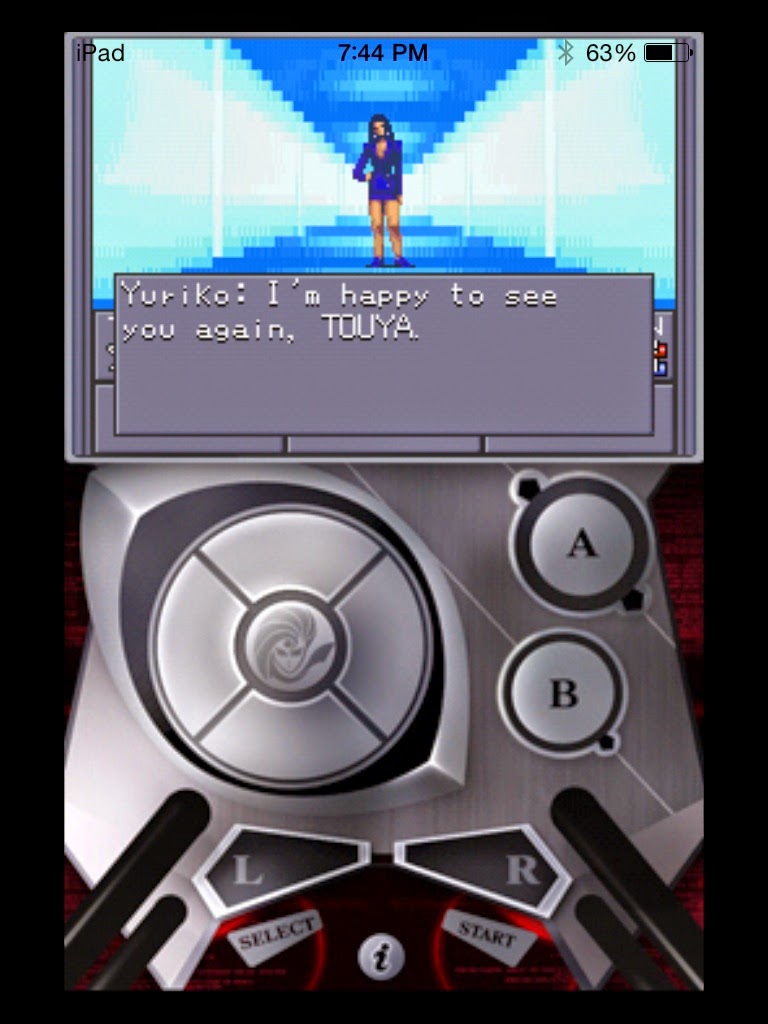
"Eternally" she says, but Yuriko does not join us. Also note the art direction; we first encounter Gentleman from the front, Champion from the side, and Yuriko from behind. Yuriko is a very layered name, derived from
yuri as in Lily flowers, and may also be influenced by the twentieth century novelist Miyamoto Yuriko, who wrote on socialism, feminism and the moral bankruptcy of postwar Japan.
Shin Megami Tensei IV players will find her especially relevant, as the real-world Yuriko's books were repeatedly banned and censored after 1932 for inciting political dissent and supporting a socialist overthrow of the imperial government, and she herself was arrested several times.
More to the point, Yuriko in this game emulates Yumiko from the original
Megami Tensei, making her out to be something of a red herring for Japanese players in the 90s.
Mother's Voice: Touya? Are you up yet?
Mother: Just because you're off school doesn't mean you can sleep all day! It's time to get up!
References to school are one of the few details we're given about the protagonist. It's easy to presume that he's a high school student because he's living with his mother, but in Japan it's not uncommon for students to live with their family while attending college or university if it's nearby.
>You seem to have received a message on your PC.
Stephen: To all those connected to the net...At present, we humans are facing an immense threat. The demons from legends and myths have awakened and are poised to attack. The only way to fight the demon threat is to make use of the demons ourselves. This program is the key. I hope that some brave soul will take this program and rise up...The demons must be fought to save humanity.
>Downloading...
>You have received the Demon Summoning Program.
>The message ends there.
The biggest difference in translation is Stephen's name; it's been STEVEN for over a decade in the Aeon Genesis translations, and that's still his name in big English letters in all of the Japanese materials. Given the capital letters and that you're first introduced to him through a '92 BBS, I'd wager that STEVEN has always been intended to be his web handle rather than a real name. The decision to make him into Stephen for the English translation puts him closer to the real-world person he's based on, Stephen Hawking. His dialogue in AG is also a lot more intense and sort of crazy sounding, like a homeless man marching around with an end-is-near sign.
Mother: You seem to have slept well last night. I think something really bad happened...
Mother: Oh, I almost forgot. Here's your allowance for this month. Don't spend it all in one place.
>Touya received 10,000 yen
Actually...Can you go buy some coffee from the cafe at the arcade? Thanks. Don't let your guard down, Touya, and make sure you're not out late, okay?
This line isn't very different from Aeon Genesis', but what makes it interesting is that it was actually first translated for
Persona 4. The dialogue is lifted almost word for word from the script used for the Void Quest dungeon in P4, which was supposed to be a deliberate callback to the first SMT game, but for players outside of Japan it was their first time encountering it if they hadn't played the fan translation.

Stepping out from the protagonist's home, it's clear that the world map has been renovated heavily for the GBA/iOS ports. The isometric tilt and greater detail on the map lends some greater depth to the exploration, but it feels a lot less crisp and colorful in the transition. On the note of SMT's different versions, the original SNES release is undoubtedly the one that westerners are most familiar with, but it seems the PlayStation 1 release from 2001 is the definitive version in Japan (where it's available on PSNetwork). It shares all of the updated content we have from the GBA port, with redone areas and new items, but there's more detail in each dungeon and higher quality sound. Having glossed over some playthroughs on the Japanese side of YouTube, and on NicoNico Douga, one thing that bugs me about the PSX port is that the sprites weren't touched up to match Kazuma Kaneko's new artworks for the characters and demons. It would be good to see a
Strange Journey- or
IV-style remake of
Shin Megami Tensei with updated sprites/character models and voice acting. The gravitas of the storyline is somewhat lost without the dramatic setpieces we've become accustomed to.
Our goal right now is the Kichijoji mall to the southwest. There's three different entrances, each of which can make navigation somewhat confusing at first, but once you've spent a little time in the hub area, going through becomes second nature.
One of the definitive differences between navigation in iOS and navigation in SNES is the polished interface. The party interface in the original game was text-only and acted like an old-school dungeon crawler display, with the party prefaced by a hash sign and each character existing on a numbered line, with the back row being represented by an indentation. The current interface originates from
Shin Megami Tensei II, where the front and back rows were more clearly defined by a visible field position, and the update to the original game was first implemented in the PSX and GBA ports.
Being a 1992 game, SMT is wrapped up in the same millennial apocalypticism that set out the plot for
Chrono Trigger and drove year 2000 paranoia. You can pretty well imagine the survival store owner sitting huddled in his basement on New Years' eve surrounded by mountains of bottled water with a yakuza-issue AK47 in hand. The Aeon Genesis translation was a little more time-sensitive in this regard, as the store owner talked about the "coming millennium" instead of "inevitable apocalypse." Given the general cultural embarrassment surrounding said millennialism and the subsequent unfamiliarity of the younger generation with Y2K theories, it's probably for the best that the translation be this explicit, but I appreciated the subtlety of the Aeon's approach.
The survivalist store is normally your first stop in SMT, as the game gives you a knife eventually and it's not worth investing in a marginally better one so soon, so armor is priority 1. Body armor carries the biggest defense and evasion bonuses, and the increases from leg, hand and head armor are so low at this point that we're better off conserving our cash; a Survival Vest by itself takes a fourth of the yen mom gave us.

We meet up with Yuriko in the cafe, confirming that our dream earlier was a little more than just prophecy. Since Yuriko remembers us, it's fair to say that Gentleman and Champion do as well. Atlus' translation makes a separate text box for Yuriko's laugh ("Hmhmhm..."), which was originally an "Ufufufu" that Aeon rendered in the (similarly unbelievable?) "Heehee," but among handling these idiosyncrasies Atlus has also periodically deleted ellipses from the text. Of course, to some translators modifying the text to that point is sacrilege, but there's an argument in favor of rendering the text in a way that native English speakers will be able to read it both naturally and prosaically. While ellipses in Japanese and English may be visually similarly, and it's tempting to preserve instances of them between translations, the actual regulated usage of this punctuation between the two languages varies immensely. That said, while there's a lot of instances of translators deleting ellipses when translating from Japanese to English, you tend not to see examples of them being
added when translating from English.
SMT's genre conventions are all but extinct these days, but a good third of the plot is exposed through speaking to non player characters in bars (or in this case, a cafe.) One of the much-appreciated features of the iOS port is that you no longer talk to each character by default just by running into them. If you pass over a map square that has a character you've already talked to, a "TALK?" prompt appears at the bottom of the screen and you can press A to speak to them or just keep walking. In the SNES release you would talk to the same person every time you hit that map square, with no opt-out. While the system's evolved considerably, the same style of presentation is carried over into modern games; I rather memorably was confused by part of
IV's chaos area plotline because I missed out on some of Akira's backstory. The cafe is mostly fluff about the police cordon surrounding Kichijoji, the investigation of a classmate's murder at Inogashira park, and there being a crazy man behind the antique shop. Another point where Aeon's translation differs is that it specifies the murder victim as the classmate
of the girl the protagonist was speaking to, where Atlus chooses to hit a little closer to home and say "our" classmate. This is another case of implicit versus explicit statements like the apocalypse versus millennium above. Japanese is a strongly subject-drop language where nothing is said if it's already understood, and the protagonist being put in the role of a student implies the safe assumption in the original language that the victim was one of his classmates.
Owner: I'll have them sent to your house. You can wait to pay for them when they're delivered.
Another little detail is the coffee mom sends us out for. Aeon's translation handles it from start to finish as just "coffee" but once you're at the cafe Atlus clarifies it as "coffee beans." This is technically a modification of the text, but it's not an extended leap of the imagination by any means. It does ease the visual image of a coffee house barista running over to the protagonist's house to deliver a cup before it cools; they're just mailing beans.
Behind the antique store is one of
Shin Megami Tensei's most oddly visceral scenes. I think everybody remembers the crazy guy despite him having all of three lines in the game. It's the type of scene that couldn't be done in a modern game like
Nocturne where you have very detailed, animate 3D models to work with.
Man: Don't come near me! N-Nnrgh...Hrrrgh, gaaaaaah...!
>Preta ran away...
>You see an Attack Knife on the ground.
>Touya obtained Attack Knife.
Hoy but did they ever sanitize it. This was the first scene in iOS that gave me pause; first because I'm so accustomed to SMT's Preta being called Gaki (and Yuuki Gaki at that rather than Ghost Preta) and second because the original line was
"Yuuki Gaki appeared, and ripped out the man's throat!!" To my knowledge, the word Preta has never actually been used in the Japanese games and the English-language name change first occurred in
Nocturne, and going from
the screenshots provided by Japanese bloggers this is pretty much the case. Suddenly having a Preta lunge out and tear a guy's throat open in the middle of Kichijoji mall leaves a strong impression of what the rest of the game will be like, and it's emphasized by the main character actually taking damage from the Preta's attack before it runs off. The shock value is huge. So the iOS version of the scene is consequently bland and comes off as an unimportant addition.
Mother: Oh, hi, Touya. Where've you been? Don't stay out too late, or I'll start to worry. Though I suppose boys will be boys...Did you hear? A girl was killed in Inogashira Park. It's becoming a dangerous world out there...I don't even feel safe walking around town...Oh, and don't forget to walk Pascal.
Pascal the dog is another bit of worldbuilding that's off to the side when leaving the main character's house. I figured it would be redundant to screenshot his barkarfwowing when we'll be seeing him come into the storyline soon enough. Right now, it's time for bed and another vision.
Champion: Yo, Touya. We're sharing another messed-up dream, huh?
Yuriko: Remember...I'm always by your side.
This is what the windowed view looks like. I prefer it resolution-wise because it displays the screen at the GBA's native resolution, but it's cumbersome for screenshots and the iPad HUD can't be turned off. Aesthetically it's modeled on the various COMPs employed by the Megaten protagonists, and in particular it seems to evoke the tech from
Soul Hackers. There is a small bit of humor in the iOS release, given that in SMTIV the majority of devil summoners use smartphones to carry around their demons.
We enter a door.
Gentleman: What the hell? What are these people doing? Are they trying to summon a demon?
Priest: O dark lord, deep in slumber...Take this young one's soul!
>The girl is being sacrificed.
>Will you save the girl?
I believe this is the first alignment choice available in the game. Ethically, I prefer to minimize harm and disavow killing where possible; although we don't know the motives of the priest nor the goal of their ritual, in absence of context I believe we should presume that this girl is an innocent victim.
Alignment in this game is 0 to 255 with 0-111 as Law and 144-255 as Chaos. Neutral is in the range of 112-143, and the protagonist's default alignment is 128 (absolute Neutral) while Gentleman's default alignment is 0 (absolute Law) and Champion's is 255 (absolute Chaos.) Each alignment choice pulls you towards itself, which means that if you're at 128 and make a Neutral choice, you will remain at 128 rather than go up or down. Genuine Neutral choices are few to none however, and most all of them will pull you up or down on the alignment axis. You can generally tell which choice is which based on whether Gentleman or Champion supports or opposes it, and while I'm making my decisions independent of going for a specific ending, I will detail how my alignment is being affected by these decisions and where the main character stands.
>Yes (Law, -5)
No (Chaos, +12)
Champion: Hey, that guy in back has a sword, and we got nothing! You're nuts!
Priest: Who's there!? Who dares meddle in the ritual!?
Girl: Touya! You came to save me...! Quick, call my name!
Priest: Th-that name...it's...Gwrahhhhhh!
Unfortunately, the Heroine is one of the few fronts on which
Shin Megami Tensei drops the ball. Women are underrepresented in the series. There is a tradition of having nonentity heroines with limited influence on the games' storylines who follow the protagonist on any of his routes, without choosing an alignment of their own. This tradition is as deeply ingrained into the franchise as the final boss having Null/Reflect Gun or as the alignment system itself, and while it began earlier in the NES era it was SMT that really codified it. Isabeau, Hiroko and this Heroine are each fantasies of male power, and one-way fantasies at that because mainline SMT does not allow for the player to choose their sex.
Nominally, the Herione appears to be on equal footing with the protagonist as the primary female voice in the storyline, and the game gives her some considerable influence that at a glance would seem progressive for 1992. The problem with the Heroine is that SMT drops the idea as quickly as it raises it. The Heroine is trapped in a supportive role and is the only core party member that will never conflict with the protagonist's worldview, and the more time she spends with the party, the less dialogue she gets. Her importance diminishes constantly until she's become almost as silent as the protagonist himself by the end of the game. The Heroine's supportive role extends to gameplay; her alignment will shift to be identical to the player's alignment. On the Law and Chaos routes, she will be Law or Chaos if he is, and Neutral if he's on the Neural route, and there's even custom sprites for the Heroine based on these. In a game about conflict and doing what must be done even if it means fighting close personal friends, keeping quiet is an awful representation for the definitive female voice.

Nadeshiko: They nearly sacrificed me. If the ritual had finished, it would have summoned a fearsome archdemon...Ahh, I can feel my lost power flowing back to me.
The patriarchal approach to the Heroine is baffling precisely because of how
Shin Megami Tensei challenges moralized institutions elsewhere. The Law alignment in SMT is a simultaneous embodiment of the complacent deference to authority that permeates the social order of modern Japan, and all the paranoia of proselytizing westerners poisoning the national spirit of the country wrapped up into one. It is the easiest alignment for Japanese players to defer to because it is the social norm, but it creates conflict because it also means choosing to suppress one's identity by yielding to a foreign deity and the same religion as the American military--compare giving the option to a Texas Libertarian to live a life of absolute individual freedom without any government, with unrestricted rights to firearms and no regulations on their sale, all in exchange for converting to Islam. Meanwhile the Chaos alignment venerates Japan's indigenous gods and promises liberation from that oppressive system of norms, but this comes at the expense and expulsion of the physically weak and disabled, and it means siding with a nationalist agenda from the same kinds of people that want war criminals enshrined at Yasukuni. Yet in spite of these challenging ideas, the treatment of the Heroine is wrapped up in the same segregation of gender roles and subservience of the female partner that created the dubious corporate "position" of Office Lady. The Heroine is supposed to be the leader of the game's Neutral faction, and consequently the player really ought to be forced to kill her on the Law and Chaos routes. If permitted to maintain her own stance, she would be the Neutral equivalent to Gentleman and Champion, but as it is the protagonist assumes that role while the Heroine is relegated to being a fourth wheel to the dialogue.
This is part of a greater problem of patriarchal control in Japanese media and culture that extends back to the early modern period, c.1890 CE. Ever since Nakamura Masanao coined the slogan 良妻賢母
ryousai kenbo "good wife and wise mother" there has been a conscious effort to stratify gender roles and restrain the rights of women in the public circle, and this agenda has been advanced by the Japanese government despite the popular support feminist movements have enjoyed since westernization efforts began. This is a country so thoroughly dominated by Confucian values that women did not obtain the right to vote until 1945, where women are still routinely made to retire from work once married, where unmarried working women are called "parasite singles" and where one of the major reasons that Japan's population kite is unsustainable is due to the dearth of working women to compensate for an absence of young male workers. Literature is similarly problematic. Despite the world's first novel being authored by a Japanese woman, the products of the Meiji-period enlightenment were male dominated and rather than portray disempowered female characters, they opted for a more total negation of feminine presence by not having female characters at all. There are exceptions and the feminist literature post-Meiji can be powerful, but even when women are portrayed in the early modern period there is a curious tendency toward portraying non-Japanese women specifically. Women as a whole have been such a nonentity in modern literature that when trying to dig up a literary name for our Heroine, the only appropriate one I could come up with is the very embodiment of that absence; "Yamato Nadeshiko." An impossible fantasy of femininity as fabricated by men.
The good wife and wise mother. There is so much unrealized potential in the Heroine that it's disheartening to put to words all the ways she could have been better handled, but most of all the protagonist's fixed sex is what could have answered these problems handily. There is a particular logical reason involving Yuriko that the plot would not want to tread through, but more than the storyline purposes it would be offensive to the 1992 male audience's sensibilities to have a female option. There is no particular reason under a Japanese belief system that the protagonist could not be female, and it would fit the undertones of other reincarnative stories like the Tanabata festival lore.
Nadeshiko is our other magic user, and a lot better at her job than Gentleman. She gets the Zio series of lightning spells, capable of inflicting paralysis ("Shock" ailment) if there's enough Ag backing them. The mechanics behind it are a little obscure, but they're the same basic principles used in
Soul Hackers. The faster Nadeshiko is, the greater ease with which Zio will paralyze demons and keep them from moving. The higher her Ma is, the more MP and damage she does. We also need her to stay alive though, so pumping Vi early on to keep her sustainable as she builds Ag across later levels is ideal. +9 Vi +1 Ag +8 Ma.
Nadeshiko: We won't meet for some time. It's fated that we part for now. But when the day arrives, come find me.
Mother: Good morning, Touya. Was something wrong last night? You were tossing and turning...you even called someone's name. Sounded like a girl's name! Was it Nadeshiko next door? Hey, why are you blushing? I'm just teasing, honey.
The domestic scenes in SMT set it apart from the later games in the series. There's an unnerving quality in the text created by having these juvenile, Personaesque conversations with mom and then walking out into the demon infested streets of Kichijoji to talk up some Pixies and Pretas.
Nadeshiko: I had a date set for today, but I won't be going anywhere now thanks to the police. Who with...? What's it matter to you who I date?
The neighbor's house does exist immediately below the protagonist's apartment on the world map, but as the Nadeshiko we encountered in our vision said, we won't be meeting the actual Nadeshiko for some time.
Owner: The strange thing is, there's a weird old guy at the entrance to the park now.
The cafe serves essentially the same purpose as the bars and pubs of 1980s dungeon crawlers, in that it's both an accessible method of healing in the field (I have never ordered anything other than a Blended and refuse to pay 600 yen for a Blue Mountain) and the information hub early in the game. It's another of those inherited tropes carried down from its
Wizardry-style antecedents.
Old Man: Are you Touya? You may be able to wield great power. Light and darkness. Law and chaos. The world's balance is on the verge of collapse. No matter which way it leans, the result will be the same. What would you do? Either way, there is no turning back now. Let me see your strength.
And so our third dream sequence begins. The Old Man is an icon of the original
Shin Megami Tensei and our Master Nankai equivalent. While Gentleman and Champion will each err towards their own ideals, the Old Man provides a critical voice mediating their tone throughout the narrative. Much like Stephen in SMTII and the little girl in SMTIV, the Old Man's appearance in the Neutral ending basically confirmed its canonicity ahead of the fact, as it's the only ending in which he reappears to tie up loose ends.
Champion: Seriously? I'm dreaming in the middle of the day?
That said, the series' writers have distanced the franchise from the idea of canonicity entirely as of
Nocturne, with the interpretation being held in-universe that all endings and incarnations of the universe have happened in parallel. The core SMT games mainly take place in a world where the protagonist chooses Neutral, but that doesn't diminish the validity of the Law and Chaos endings.
We travel up several floors.
Mother: ...I know I can't stop you. But if you die, what am I supposed to do then...?
The layout of this dream is important because, although blurred and in poor resolution blown up on iOS, it corresponds one to one with an upcoming dungeon. Incidentally, this is the only time that the protagonist's mother addresses Gentleman and Champion directly, and much as our meeting with Yuriko in our first vision was indicative of a real encounter, this conversation straddles the line between dream and reality.
Summoner: My brethren! Come to this world, from the Expanse!
This is the first time we see SMT's unique brand of science fiction fused to mythic trappings. The gate surrounding the summoner's computer terminal is a Shinto
torii, a religious boundary between the sacred and the mundane that is normally built outside of shrines. The women flanking him are miko, shrine maidens typically charged with ritual duties, and the wands they're waving are
gohei, used in cleansing rites and stock depictions of Japanese ritual magic. The conventions being used here are all very familiar to native Japanese players, who would have encountered Shinto shrines daily, and seeing them married to a demon summoning ritual has a certain impact to it that doesn't carry through. I think that for Americans at least, we're so unaccustomed to the idea of demon conjuring that the impact is present, but it's different because it's crossing a boundary of acceptability rather than appropriating our indigenous religious beliefs. The involvement of specific Shinto imagery here is important, as it's an early clue on what kind of role the Shinto pantheon will play later in the game.
Regarding translation, the major difference between this translation and Aeon Genesis' is the use of the term Expanse. The original Japanese term is 魔界
Makai the "world of evil spirits," but the
Ma kanji can also be read here as "demon" or "witch," it's used in the words for witchcraft/sorcery and red-light district, and
Makai has been liberally translated as "hell" in some instances. "Demon world" is a direct if nonfluid translation, while "devil world" is the name used in the soundtracks. Aeon called it the Abyss in both their SMTI and SMTII translations, and this was a pretty appropriate translation for conveying a world to which the demons have fallen into, but the Expanse is a carryover on Atlus' part from SMTIV. In
IV, the world of demons is a world of possibility and raw (untamed) imagination; the desires and beliefs of mankind take shape there, giving rise to demons as the manifestations of their desires. Conceptually, an "Expanse" implies a vast, constantly opening space or endless horizon, which is appropriate for a world where thought and desire take physical shape. I'm partial to the Abyss or (to borrow from Milton) Tartarus as a translation, but Expanse is appropriate for the shared nature of demons and mythology in the franchise.
Summoner: Hrm!? What are you playing at, waltzing in here like this!? Sadly for you, you've seen the ritual. Which means I can't let you live...
The battle with Douman is partially scripted, in that we have the freedom to attack as we please but ultimately can't win before the vision ends automatically. We do get a peek at Gentleman and Champion's characteristics, with each armed with their basic Wind and Fire spells. This is an opportune moment to talk about the translation of demon races in the games, especially since Meta isn't a very good equivalent for the Choujin race. Douman's race in Japanese read literally is "great man" 超人 and is comparable to the German term ubermensch or its English equivalent the "overman." The race is normally reserved for the carnate forms of different alignments, and normally human characters at that; it's also rarely used and after SMTI only really comes up again in
Strange Journey. The meaning of it is supposed to identify an exemplary pinnacle of humanity (Douman himself is derived from a Heian era sorcerer rather than an actual demon) so the Meta translation doesn't really convey the idea, but "Super" would be rather lame in English and "Uber" has been sullied by overuse on the internet. One approach would be to translate it as Hero (not to be confused with the Famed race) or simply Great. Many of the races in
Shin Megami Tensei have problems with their translated terms losing the meaning of the original text in some form or another, and are exemplary of the kind of balancing act that translation plays. For another example, see the Kyoushin "Mad God" race being translated as Zealot.
When I first began looking for information on Douman I ended up in the completely wrong part of the internet, so I demand that any readers also suffer through this
alternative origin for the demon. DOUMAN-SEIMAN-DOUMAN-SEIMAN!
Old Man: If fate will it, you will surely encounter him again. Take caution when you do...
The warning flags being raised here are interestingly divergent from modern conventions. Essentially, SMT is broadcasting a message at the player that there's an unwinnable fight coming up and that we have to prepare for it somehow. Yet in spite of that, the majority of modern players--and this is not just cultural boundaries speaking, because I've seen Japanese players on NND making the same exact mistake--presume that they can somehow outlevel the upcoming rematch with Douman instead of go around to find an alternative solution. What SMT is trying to communicate here is that conventional means will not be enough for Douman, that we're going to approach him as a puzzle rather than as a boss fight.
Policeman: You're under arrest! Get him!
This is where the little details of worldbuilding start to come together. The outer wall of Kichijoji has been under police guard since the beginning of the game, but on the return trip home from Inogashira is the first time we're forced to speak with them. In Aeon Genesis' translation the policemen say
"You're under arrest for murder! We found your blood fingerprints at the scene! You sick little puppy, tearing out that guy's throat like that! Restrain and handcuff him, boys!" I have to presume that these details were purposefully omitted in order to go along with the censorship of the man's death behind the antique shop, barring the possibility that they were absent in the Japanese iOS port.
While this censorship cuts out some of SMT's visceral charm, more alarmingly it also deletes a certain plot point regarding the policemen that tends to sway players' opinions on the Law versus Chaos alignments.
Young Man: ...Were you taken captive too? ...Oh. Are you...?
Gentleman: Touya, you have to listen to me. My girlfriend's gone missing. I tried to find her, but I was attacked by demons...While I was fighting them off, the police came and arrested me. I need to hurry and find my girlfriend...Could you help me find her?
>YES
Another difference between translations is that Gentleman in AG's text said that he was arrested for killing rather than "fighting off" the demons. The whitewashing of instances of "kill" is bizarre and I'm convinced it's to meet the 4+ rating on the iTunes store. At this point the censorship only confuses the narrative. What Okada and Kaneko want to convey is that the police and the demons are in league with one another; the demons kill people, the police frame it on a mark, then arrest and bring them to the hospital. If the mark resists and kills the demons, the police have to make good with their demonic sponsors by bringing in the demons' killer.
An interesting cue is that this is the first time we hear the original Law theme. The music direction in SMT is primitive but effective. You can generally recognize the hymnlike quality of the melody as embodying the Lawful worldview without having to refer to a tracklist to see what it represents. Similarly, the theme for Chaos is filled with a foreboding awe emulating that of the ancient world and the aesthetics of the old gods. It's not as beautiful or engrossing as
Strange Journey or
IV's soundtrack, but it communicates the ideas clearly and that's all art needs to do.
Gentleman: My girlfriend's name is Nadeshiko. What? You're Nadeshiko's neighbor, Touya? You live right next door to her...
>You hear a sound from the room to your right.
>Gentleman leaped at the worker!
Gentleman: All right. Let's use this opportunity to get out.
A little detail about Gentleman is that even though he has spots of his ideals already embedded in him as in the dream sequence with Nadeshiko, when starting out he's still able to do reckless and proactive things like attacking unarmed hospital workers.
The hospital is
Shin Megami Tensei's first real dungeon. It's not an especially memorable location in itself, but it's remembered for the things that happen inside of it. This is how most of the dungeons in SMT work. The smaller ones you tend to have the layout of memorized, not because of the beautiful scenery or unique concept, but because of the oppressive tone of conspiracy and the kinds of people you meet within it. The police arresting you for a murder you didn't commit, then handing over untried suspects to off-the-grid surgeons, and when you break out you find the whole job being run by demons and the hallways flooded with Pixies and Weredogs. The aesthetic is comparable to breaking into the Shinra building in
Final Fantasy VII, a sense of being on the run even as you storm the castle, but your resources are infinitely more limited in
Shin Megami Tensei.
Gentleman is our crutch character for now, he starts with the single target healing spell Dia and quickly learns the force spell Zan, which hits for more than double either character's physical attack and is our main method of dealing with demons aside from using demons ourselves. By the time we get through the dungeon he's also learned the multitarget force spell Mazan, as well as the automap-displaying Mapper.
We enter a room off to the right.
Man in Wheelchair: My last project was a teleportation device...The Terminal System. But my tests inadvertently brought demons to our world. I killed them, somehow, but was injured in the process. That painful experience led me to develop a new program. You know it as the Demon Summoning Program. Unfortunately, a man named Gotou was very clever...He realized the Terminal is connected to the Expanse. He's now trying to summon and control demons himself. So I'm disseminating my program to the people. The more people who can control demons, the better. Hopefully that will keep them from running rampant. Alas, the program seems rather difficult to master. If there's anything you need help with, I'll be here. I've unlocked the director's office on the second floor. Flip the last switch there, and the way out should open.
He doesn't give us a name, but the backstory for the Demon Summoning Program tells us right away that this is Stephen. The art of subtlety is unfortunately lost on a lot of scenario writers, and like with the collaboration between the police and the demons this point is very well conveyed by SMT. For the duration of this dungeon Stephen will act as our free heal spot and save point, a role that he's come to reprise in the later games. Having access to early and immediate healing is important, because it makes his room our temporary base of operations while we're building up in the first dungeon, giving us time to recruit all of the demons here and grind up our stats.

Negotiation in SMT is fairly rudimentary. You open by either taking a friendly or threatening approach, then the conversation branches out into the demon posing a statement and you responding with a binary answer. Each demon has a few limited ways to recruit them, which can be somewhat unreliable, but in general I've found that being a self-centered jerk is the fastest way to get them to finally let you make an ally, yen or Magnetite pitch. On that note, Magnetite is an equivalent to the often-obscure food mechanics of past dungeon crawlers, which exists to fundamentally limit how long you can have demons active, but in practice the game throws so much at you in treasure chests (and eventually random encounters) that it's very easily ignored. It's not until
Nocturne that the series really threw off the rules it's drawing its roots from, so the mechanic persists in
II and
if...
The hospital has five encounters; Therian Weredog, Fairy Pixie, Spirit Ghost, Spirit Preta and Jirae Knocker as the rare encounter. None of the Spirit-order demons can be recruited because they're Dark-aligned and so won't negotiate with you. SMT expects you to get accustomed to failure, and so it takes many attempts, but I use the time to grab up each of the recruitable demons. The Weredogs that I do defeat (you can only have one of each demon at a time) drop the Spiked Rod, an upgrade over the Attack Knife and another reason we don't buy weapons from the survival shop.

This is what Pixie's "character sheet" looks like. Her primary stats are In and Ma, and she comes with the Hapirma, Dia and Zionga spells. Hapirma inflicts a weird status effect unique to SMTI&II, Happy, which causes characters to pass their turn for as long as they're inflicted with it; it's a little redundant because sleep (inflicted with the Dormina spell) and paralysis do the same thing, which is why it hasn't come back for later entries. Dia is the same healing spell as Gentleman's, and Zionga is important as a
very early second level single target lightning spell.
Shin Megami Tensei only has two levels of offensive magic, so the leap between first and second in damage is enormous and Zionga will deal massive damage if Pixie uses it, and lightning spells can also randomly inflict paralysis based on the user's Ag. The catch is that Pixie only has enough MP for a single casting. So Pixie is a mixed magic attack, support and status effects inducer, but she's better at support than the other two categories. She also resists Expel and Bind, so light instant kill spells Hama and Hamaon will rarely hit her, while Shibaboo's 50% chance to inflict Bind will be cut down severely. Demons in the first and second games do not level up, so we'll want to fuse her into a stronger demon as soon as better things are available, but Pixie is fine for bringing in against the first boss.

Weredog meanwhile is focused on Vi so he has higher HP and thus better longevity in battle, but his other stats are lackluster. His extremely low St makes his physical attacks far less intimidating than they could be, and the same goes for his abilities Feral Bite. Abilities are different from magic in that they're innate to demons' physical characteristics, usually operate off of St rather than Ma, and don't cost MP. So Weredog deals free damage higher than physical attacks, but it's still pretty pathetic compared to Gentleman's Zan or Pixie's Zionga. Weredog also has Rakukaja, a party-wide defensive buff, and Diarama a single target second level heal. Buffs in SMT can stack up to +8 while debuffs can stack up to -4, so if you have the maximum eight Rakukajas cast and the opposing team has cast Rakunda the maximum four times, your side will still be at +4 defense. Buffs are important in SMT because each stage has a dramatic effect on the parameters they control, way more than in
Final Fantasy. Healing magic in SMT has three levels, so Diarama isn't quite the ultimate single target heal. Weredog's role is primarily as a combination of buff and physical attacker, with emergency healing. Unfortunately he resists nothing and is weak to Gun/Elec so enemy Pixies can deal heavy damage if they get off a Zionga and human characters will give him a lot of trouble.

Jirae Knocker is In and Ma-oriented like Pixie, but with vastly better base stats. Like Gentleman he gets Zan, as well as the status-inducing Shibaboo and party-wide attack buff Tarukaja. Like Weredog, Knocker will be serving a buff role, but he's also our secondary magical attacker after Gentleman. Despite being amazing statistically for his level and for his spell list, Knocker is weak to Force, all types of magic and Almighty, which are absolutely awful elements to be weak to. Almighty is typically the endgame element of choice in Megaten, sometimes trading that role with physical attacks, and having a weakness to magic is crippling in general.
Regarding alignment, we can only recruit demons of the same or one alignment removed on the axis. Since we're Neutral that means that we can recruit all Law, Chaos and Neutral demons, but if we were Chaos we could only recruit Chaos and Neutral demons, and vice versa for if we were Law-aligned. These rules don't apply for the demons we fuse ourselves.
On the second floor of the dungeon...
>NO
Director: I see. Then you're still wicked humans that won't obey my command. Allow me to modify you to become my puppets.
We pick up a St Incense on the second floor of the hospital and then head over to the Director's office. Incenses permanently increase a character's stat by +1, but I'm refraining from using them on my character just yet because I don't anticipate that he'll be attacking very often in this playthrough. (There's also the fact that gun damage is independent of physical attacks and therefore it's arguably a waste of an incense on him.)

Orias has Pulinpa, Dormina and Hapirma, so his main strategy is based on inflicting Panic, Sleep and Happy to prevent us from casting magic and wasting our turns. The catch to that is that he's not so great at dealing damage, so we still have a pretty big window to recover from the status effects and heal up. The protagonist tosses around healing items and occasionally does a low-effort physical attack, Gentleman casts Zan, Weredog buffs with Rakukaja and then goes into Feral Bite/Diarama, Knocker buffs with Tarukaja and attacks with Zan, and Pixie does one round of Zionga before focusing on Dia. Orias drops ¥480 and 200 MAG on defeat, and that's a wrap for the hospital.

There's a couple places to investigate coming out of the hospital. Now that Master Nankai's no longer blocking the way into Inogashira park, we can access the Cathedral of Shadows to the south, as well as check out how the overworld has changed since we've left the hospital, but our main goal is to head back to Kichijoji mall.
This man is skulking around where the police arrested us. In AG's translation he's very high-and-mighty about it, saying
"I hear they arrested a psychotic murderer here. It makes me feel better to know that a lunatic like that is off the streets!" In Atlus' translation he doesn't have anything like the second line.
Kichijoji's Cathedral of Shadows is a small building divided between the Cathedral proper and a medicine shop. Mido holds the ceremonies for SMT's trademark fusion procedures, an occult marriage of magical and scientific knowledge that brings (traditionally) two demons together to create a new one. The term "Cathedral of Shadows" was first used in
Nocturne, while AG translated it as Jakyou Manor, and the Japanese used is
Jakyou no Yakata or "Mansion of Heathenism." This is more in line with what the house of fusion is like prior to
Nocturne; it's a small estate run by a solitary occultist who's presumably sharing the rent with the local healer. Thematically the Cathedral is an outcast place where hidden knowledge and esoteric ceremonies are welcomed, a place for the suppressed religions of the old world and the things that the authorities would rather lock away. It's a specifically heathen ground which provides a starting point for fledgling devil summoners, and one of my disappointments with the Law routes of each game is that none of them involve destroying the Cathedral and hunting down its master.
Shin Megami Tensei has three types of fusion; two-demon fusion, three-demon fusion and sword fusion. No special fusions as those were invented in
if..., and sword fusion is limited to six specific swords designed to be used in fusion, but two-demon is normally enough for our purposes. While fusion will yield stronger demons than we can find in the field and should be pursued at all opportunities, it is a form of rule magic and the rules are binding. The law of subjugation prevents us from fusing demons past our level, and the rule of fusion is that the resulting demon's level will be the combination of the component demons' levels divided by 2 (exceptions are made by mythology.) Each combination of races also always results in the same race. Three-demon fusion uses an alternate ruleset to make stronger demons with more components, but often results in demons that are far too high level for us to summon.
So testing out the combinations, we have Weredog, Pixie and Knocker;
Lv5 Therian Weredog x Lv2 Fairy Pixie =
Lv10 Brute Azumi
Lv5 Therian Weredog x Lv4 Jirae Knocker =
Lv6 Fairy Goblin
Lv2 Fairy Pixie x Lv4 Jirae Knocker = Lv10 Brute Azumi
And with all three;
Lv5 Therian Weredog x Lv2 Fairy Pixie x Lv4 Jirae Knocker =
Lv13 Foul Slime
Presently the fusion level limit is at 8, so Azumi is just barely out of our reach. Personally, I don't like the look of Weredog and Knocker's weaknesses, but Pixie blows her reserves so fast that it'd be much easier to dump her for Azumi. Since that's not an option, I throw Weredog and Knocker in the blender to make a Goblin and resolve to rerecruit Knocker later. The digitized CG images in the GBA/iOS ports are fascinatingly early 2000s in the same way that
Soul Hackers is fascinatingly 1990s, but I prefer the cleaner look of the SNES fusion chamber.
Goblin is a worthy successor to Knocker, with Tarukaja (attack buff) Sukukaja (evasion buff) and Makakaja (magic buff.) His raw HP and MP are great, his stats are evenly spread from St/In/Ma and while his Ag is lacking as a result he has no weaknesses and resists Expel. It's one of those little support demons that you only really appreciate after you're familiar with the actual game mechanics.

In addition to the Cathedral proper we have the Ashram. This is one of three alignment-specific healing shops, with the Ashram being specific to the Neutral alignment. Each shop will heal your party for a fee, as well as sell healing items and items to prevent instant death. Each time you use one it slightly polarizes you towards its alignment, which as I've said before is on a scale from 0 to 255. The more you use the Neutral healing house, the more your alignment is pulled towards "Absolute Neutral" 128. Similarly, the more you use the Chaos aligned shop, the further your alignment swings towards "Absolute Chaos" 255, and the more you use the Law aligned shop the further you slip towards "Absolute Law" 0. Killing demons of particular alignments also affects your alignment on a very small scale, but the adjustments are so small that it's almost not worth mentioning. Right now our alignment is at about 123, so using the Ashram would pull it up. I'm going to be deciding which healing house I use based on which way my alignment has been swaying, but right now I don't need it.
On a translation note, Aeon Genesis' translation used a literal transcription of the Japanese term
Kaifuku "Healing."
Kaifuku can also be used as a verb, "to heal/
kaifukusuru" and is more general purpose than an Ashram. By translating it as an Ashram however, Atlus gave the Neutrally-aligned healing shrines their own identity, associating it with spiritual instruction that is neither Abrahamic (Law) nor shamanistic (Chaos.) I find the Ashram translation preferable, even though it treads the ground of embellishment.

On our way to the mall I make a stop at the train station. From hereon out all of the police officers on the overworld map are replaced with soldiers, reflecting the declaration of martial law to contain the demons, and drawing on a particularly fearful imagery from Japanese history. For Americans, the idea of martial law is scary in the way that nuclear war is--neither of these things have been experienced by most Americans, nor has a real precedent been made to think it could happen as an everyday danger. Martial law in my country's history is all very far back in the eighteenth and nineteenth centuries. In Japan however, the American occupation from 1945~52 is still collectively remembered through grandparents and the legacy passed down in public education. The image of martial law is also directly opposed to the strong antimilitarist sentiments of the general public, which while severely toned down since the 70s as the second World War has become increasingly distant from the current generations, is still a major obstacle towards the development of the Self-Defense Force in Japanese politics. It's comparable to McCarthyism in the United States, far back in history but still infamous enough to spark realistic fears when brought up.
Inside Kichijoji mall...
Ozawa: What the hell are you talkin' about, demons? Hey guys, let's beat this guy's ass!
>A gang has cornered a young man and is beating him.
Gentleman: That's so cruel...I can't allow this.
From an artistic perspective, this scene is framed interestingly.
Shin Megami Tensei uses static sprites to represent its characters, with some minute movements for in-battle sprites. The visual novel-like presentation of the text and cast is built around the constraints of the 3D dungeon crawler gameplay, and as far as I can tell this mode of storytelling began in Japan with
Megami Tensei. Movement is conveyed by characters fading out of the scene or fading to a different position on the screen, as if pushing down or sliding the pieces of a pop-up book. Only a very small number of important core characters like Champion get multiple sprites with different positions.
Young man: ...I won't give in...to assholes like...you...
Gentleman: Are you all right?
Young man: Shut up! Do I look all right to you? If only I had power...Then I'd...
Gentleman: What should we do, Touya? He's still talking like that.
Young man: You called him Touya, didn't you?
Young man: That must mean that you're Gentleman...
Gentleman: ...You must be Champion.
Champion: I see. Well, it looks like you saved me. Augh...Dammit! If only I had more power...I can't even beat these bastards by myself...How am I supposed to beat demons if I can't even fight Ozawa? Please! Let me join you! Well, I'm coming whether you like it or not.
>Champion has joined the party.
Sometimes I have trouble buying the ages 4+ rating. Champion is a hotblooded and abrasive character, somewhat atypical of the Chaos alignment compared to the more laid back, all-business Jimenez in
Strange Journey or the snakelike Naoya in
Devil Survivor. One of the surprising aspects of the Law and Chaos alignments in SMT is that while there is a deliberate motion to bias the player in favor of Gentleman by comparing his and Champion's introductions, strong support for Chaos has emerged both in Japan and overseas. I think it's a testament to the strength of rhetoric that Okada sets the player up to dislike Champion in full confidence that they can be persuaded to support him after seeing the remainder of the game.

Champion enters the party far behind, still at level 1, but will catch up quickly as long as we take the time to build him on the world map. He gets Agi (Fire equivalent to Zan) but his most important early spell is Patra, which cures all of the Nerve ailments (basically anything mental rather than physical; Panic, Happy, Bind, Sleep, Silence and Charm.) So Champion is our primary physical attacker, with an ailment recovery role. Really, the most useful spells that he gets are all recovery or supporting, as he'll eventually be able to cure every ailment except for Freeze, Shock and Bind.

While building up Champion I went ahead and recruited the last recruitable demon that we're missing from the overworld map, Jirae Brownie, and also rerecruited the Weredog and Knocker that I fused for Goblin earlier. Foul Mou-Ryo also appears, but like Spirit Ghost is Dark-aligned and so cannot be recruited. Brownie is Knocker's awful little brother, with the same general stat focus but less of everything. His abilities are Sukukaja (evasion buff), Sukunda (evasion debuff) and the skill Happy Step (inflicts the Happy ailment.) He's weak to Force, magic and Almighty skills, so he's good for decreasing the likelihood of you getting hit overall and wasting the enemy demons' turns but comes with the same crippling weaknesses as Knocker. The real benefit of Brownie is that it gives us access to two demons of the same race early on, which if you'll recall the rule that we can only have one of each demon at a time, makes it naturally difficult to do this so early in the game.

With all five demons available that brings our available combinations up to;
Lv5 Therian Weredog x Lv2 Fairy Pixie =
Lv10 Brute Azumi
Lv5 Therian Weredog x Lv4 Jirae Knocker =
Lv6 Fairy Goblin
Lv2 Fairy Pixie x Lv4 Jirae Knocker = Lv10 Brute Azumi
Lv4 Jirae Knocker x Lv2 Jirae Brownie =
Lv8 Element Erthys
Lv4 Jirae Knocker x Lv6 Fairy Goblin = Lv10 Brute Azumi
Lv2 Fairy Pixie x Lv6 Fairy Goblin =
Lv11 Element Aeros
Lv2 Fairy Pixie x Lv3 Jirae Brownie = Lv10 Brute Azumi
Triple fusions;
Lv5 Therian Weredog x Lv2 Fairy Pixie x Lv4 Jirae Knocker =
Lv13 Foul Slime
Lv6 Fairy Goblin x Lv2 Fairy Pixie x Lv2 Jirae Brownie =
Lv16 Megami Ame no Uzume
There are other triple combinations obviously, but they all result in one of these two demons. Ame no Uzume is the strongest thing we can fuse with the demons available to us right now, and considering that her components are mostly trash and Goblin's easily replaced I
would fuse her if I could, but I'm half the required level to handle her. Instead my plan is to fuse Aeros using Pixie and Goblin once I'm at the appropriate level, then rerecruit a Pixie for fusion with Weredog into Azumi, and here and now I'm going to fuse Knocker and Brownie into Erthys. Let's talk about why same-race fusions are so special.

Fusing two demons of the same race will result in one of the eight Element demons, which are effectively in two tiers; the four primordial Greek Elements Erthys, Aeros, Aquans and Flamies, and the four Paraclesian alchemical Elements Gnome, Sylph, Undine and Salamander. Elements are important because they let you rank up or rank down another demon through fusion with the Element, depending on whether the Element has a positive or negative interaction with that demon's race. They let your demon move "up" an order into the next highest demon of the same race, but are also effectively the keys to powerful demons because you can also rank down the lowest level demon of a race and
roll over the ranking table, ranking "down" that demon into becoming the highest level demon of its race. So for example, the Fairy race has a negative relationship with Erthys' attribute, so by fusing Pixie and Erthys we would get the highest-level Fairy demon,
Lv64 Fairy Oberon. The law of subjugation still applies though, so we would need to be level 64 to fuse Oberon.
More typically, Element demons let you bypass the normal restrictions on what kinds of demons you can fuse based on what's available in your area as fusion material. Aeros has a positive relationship with the Fairy race, so if I were high enough level to fuse Aeros I could then rank Pixie up to Goblin, or Goblin up to Jack Frost, or Jack Frost to Pyro Jack etc. Having access to one race and its positive and negative Elements gives us access to the entire order of demons, with level being our only restriction. Taking an index of the races we currently have available, the Therian race is pretty worthless except for compendium completion, as there's only two other members besides Weredog and their abilities are mostly weak physical attacks, while the Jirae race has some okay early and mid-level demons with buffs and second level spells. The Foul race that we can access through the Slime triple fusion can only be completed through Element fusion, but the only member of it that's really worthwhile in battle is the level 44 Backbeard. The Megami race on the other hand is consistently great at support and we'd get a lot of long-term mileage out of fusing Ame no Uzume and ranking her up with Elements. Eventually that would lead us to
Lv64 Megami Lakshmi, tied with Oberon and Fudo-Myo-O for the bottom place in the top 20 highest level demons in the game.
Erthys himself is a pretty good buff demon, with Rakukaja, Sukukaja and Tarukaja, but our party's somewhat skewed towards buffing right now and I'd like to update it with more variation, dedicated damage dealers and healers. Gentleman and Champion will cover the offensive bases for now. Unfortunately, Erthys shares Knockers' terrible Force/magic/Almighty weaknesses.
Mother: I'm always ever so worried about you. But at least you're back safe now. I'm so glad...Come and give your mother a kiss...What's wrong? Why won't you come to me? You know I love you, no matter what. Come here, darling!
Gentleman: Something's strange...
Champion: Yeah, there's definitely something fishy about this.
Demon: Damn...looks like I couldn't fool you. I've already eaten your mother...but don't be sad. You'll see her again soon. In my stomach, that is...But first, let's see how deliciously you struggle!
This is one of the iconic moments in SMT. The dramatic irony of the scene with the hero's mother in the Douman vision was that it contains her last words to him; she's worried over the safety of the hero and his friends, when unbeknownst to her she's about to die at the hands of a demon.

Jaki Amanojaku is an ogre from the fairytale of the Melon Princess, where he impersonates the protagonist by wearing her clothes after she foolishly let the demon into her house against her parents' warnings. I approach this fight with Goblin, Pixie and Weredog in the back row; Pixie Ziongas once before switching over to Dia support, Weredog sets up Rakukaja and then goes in for physical attacks, and Goblin does those wonderful Tarukaja/Sukukaja tricks. Champion's physical attacks hit like a tank, ditto on Gentleman's Zan, and the protagonist fills in the gaps as needed. The worst thing that Amenojaku can do is use Makajama to silence Gentleman (he does) effectively neutering half of our damage dealing strategy. He has Tarunda to debuff our attack and Rakukaja to buff his defense, but it's more annoying than anything else. A lot of the bosses in SMT don't measure up to the trash mobs because there's nothing quite as intimidating as a swarm of eight phys-reflecting demons throwing out Shibaboo and Tentarafoo for Panic-Bind so that you can't even fight back against their Megidolas.
(There is no such enemy encounter in this game.)
Amanojaku drops ¥576 and 240 MAG on defeat.
>Touya obtained ID Card.
Gentleman: ...Don't be too hard on yourself. This wasn't your fault.
Champion: Give it a rest, Gentleman. Let the guy alone...His mom just died.
A conflict in coping with grief. Gentleman chooses to try to give his condolences and console the mourner in a western-style funerary practice, Champion chooses to let the protagonist have his dignity and grieve uninterrupted, which is more in line with native Japanese funeral observances.
>Pascal the dog jumped in. It seems as though he wants you to take him along.
>Pascal the dog is tagging along.
And
this is the biggest gameplay change from SMT SNES to SMT iOS. Just like the Game Boy Advance port, the iOS edition has vision items that let you see new screens from other characters' perspectives.
The scenes are viewed through the same Compendium menu used to see the demons you've collected, accessed from the main menu, and mainly focus on the last moments of particular characters. This is the first time I'm seeing these scenes, and I think it's the same story for most English-speaking players as they've never been translated before.
Accessing either the Demonic Compendium or the vision items requires logging into DDS-NET, and of course it's wrought with the same gaudy trappings as the rest of the game. Connect line 666; one wonders if this is what Aleister Crowley's internet would look like.
Using DDS-NET requires loading an existing save file to bring up the demon and vision item data from. Dictionary is this game's incarnation of the Demonic Compendium, while Visionary lets us see any scenes associated with the vision items in our inventory. The use of the ¥ in the DDS-NET board names is an interesting setpiece; because of the standard character set adopted for computing in 1969, the yen sign has the same byte value as the backslash in American character sets, and as a result is used wherever the backslash would be in Japanese computer systems.
This is also why computer file directories in the early to mid 2000s suddenly filled with yen symbols when you switched to a Japanese locality. I have no idea if this happens in Windows 8.
>The doorbell rings.
Voice: Excuse me, can I trouble you with a couple questions?
Mother: About what?
Voice: People have been going missing around here lately. That's what we're investigating.
Mother: Pardon me, but...who are you with again?
Voice: Oh, didn't I mention? Sorry. I'm with the police.
Mother: ......
Voice: Would you please open the door?
Mother: ...We're fine here. Please leave.
This scene imitating Amanojaku's native myth, where he repeatedly asks the protagonist of Melon Princess to let him into the house, and she continually denies him after remembering her grandparents' warnings about the demon. In that story the protagonist was goaded into continually letting Amanojaku let a toe, then a foot, then a leg, a hand and eventually his head in. There is allegedly a grimdark incarnation of the story floating around where Amanojaku kills the girl and wears her flesh, but I suspect this is just an invention by the SMT fandom as there would be no story if the girl died.
Voice: Um, but...This is the police. Please open up.
Mother: My son and I are fine as we are. Please leave.
Voice: Your son...Would that be Touya?
>Your mother hastily threw open the door!
Mother: Office, did something happen to Touya!?
Mother: What...?
Policeman: I was just taking a look into what you were thinking...
Mother: Aaaaaaah!
Amano Sakugami: Heh heh heh...
Mother: No...Touya...!
On that very

note, next time I'll get around to Pascal's purpose and some more version differences. SMT opens up a lot after Kichijoji, and it's in the aftermath of all this that Gentleman and Champion begin to really make their points philosophically. At the end of this update our party is all around level 8~9, and excluding the initial 18 stat points we got to throw around this is how the team's developed:
Touya: +5 Vi +2 In +1 Ag
Gentleman: +3 Ag +5 Ma
Champion: +3 St +2 Vi +2 Ag
References
Elison, George. Deus Destroyed; The Image of Christianity in Early Modern Japan. New York: Harvard University Press, 1973. Print.
Gordon, Andrew.
A Modern History of Japan: From Tokugawa Times to the Present. 3rd ed. New York: Oxford University Press, 2013. Print.
Yamakawa, Kikue. "Record of the Generations of Women." Trans. Mikiso Hane.
Sources of Japanese Tradition. 2nd ed. Ed. Wm. Theodore de Barry, Carol Gluck, and Arthur E. Tiedemann. New York: Columbia University Press, 2006. 482-86. Print.
Mason, Penelope, and Donald Dinwiddie.
History of Japanese Art. Second ed. New Jersey: Pearson Prentice Hall, 2005. Print.
Nakae, Chōmin.
A Discourse by Three Drunkards on Government. Trans. Nobuko Tsukui. Trumbull: Weatherhill, 2004. Print.