Showing posts with label ios. Show all posts

Tuesday, May 12, 2015

Megaten and Shugendō: Let's Play Shin Megami Tensei iOS Part 3

Shin Megami Tensei is a series uniquely effective at giving the player time to reflect. Other role-playing games do this, but not nearly as often nor as strongly. The player is lead to the climax of an event, typically involving an alignment choice that she has chosen to support, and the devastation of that one moment is punctuated by a long stretch of white noise gameplay that gives her an opportunity to meditate on why she chose to support that alignment. It's a sublime use of the dungeon crawler genre, turning the long and complex dungeons into a space to think. Moreover, the games follow these meditative moments with critical looks at the alignment options, promoting a better understanding of what the player should do in the future.

This paragraph alone will contain spoilers for Shin Megami Tensei IV and Strange Journey, so highlight at your own discretion: I find the Diamond Realm sequence very much comparable to the first visit to the Yamato Perpetual Reactor and the events with Jack's Squad during the exploration of sector Grus. The climactic events involve the player being hurried into a free-for-all between the respective Law and Chaos forces of each game, culminating in the respective nuclear bombardment of Tokyo, appearance in Blasted Tokyo and the deaths of either Jack's Squad or the demons they experimented on. In IV, the player is intended to believe that their actions (killing Tayama and opening the gate to the Expanse in the Chaos route, or assisting Jonathon to uphold the rule of law against the Black Samurai in the Law route) would create a world not unlike Infernal and Blasted Tokyo. With so few clues provided to them, these routes come to resemble the distant future rather than alternate presents as they are intended, and that inculcates the player with a sense that she would prefer one of the other options. In Strange Journey, the horror at either killing Jack's Squad or murdering the demons with Zelenin's song pushes the player to the option they did not choose, or to look for an alternative solution.

Man: I am En no Ozuno. Now then...it seems two others have also made it here. Two that you know well. Go and find them. I shall explain once you are all gathered. If you need rest, my familiars Zenki and Goki in the next rooms shall see to you.
En no Ozuno is a semi-historical seventh century mystic who founded the Shugendou ("Way of Studious Trial") religion, an esoteric hybrid of Shinto, Buddhism and Taoism that proposes the attainment of enlightenment through unity with the gods of the land (kami.) Whether En no Ozuno genuinely existed or not, the predominant form of Shugendō arose much later. In the twelfth and thirteenth centuries the doctrine of "inherent enlightenment" (本覚思想 hongaku shisou lit. "real awakening thought") became popular with the Tendai school of Mahayana Buddhism, and the doctrine then disseminated down from Mt. Hiei to become the foundation for the other religious movements of Kamakura period. (Miyake 12) According to hongaku shisou, all things from the grass to human beings hold the innate qualities of Buddhahood. Eminent Buddhist scholar Miyake Hitoshi came up with the apropos description of inherent enlightenment being "animism in Buddhist garb." The Shinto notion that there are kami in all things, and the Tendai idea of enlightenment in all things have an obvious parallel line of thought. Shugendou adapts both ideas.

The fundamental principle of Shugendou is that all human beings have the same character as the cosmic Buddha Dainichi Nyorai, and his manifestations. Through becoming aware of this and practicing ascetism, humans attain buddhahood. Practitioners may attain supernatural powers, but they are supposed to use these powers positively to cast salvation rites for others. (Miyake 124) The powers granted through practicing within sacred mountains are part of the appeal. You could say that the history of Shugendou is a biography of different mountains.

En no Ozuno was said to have practiced at Mt. Yamato Katsuragi in Nara prefecture, but from the very beginning in the eighth century the different branches of Shugendou ultimately came to settle on other sacred mountains. The common thread between all the branches is Kumano Shugen, the form of Shugendou based out of the three mountains of Kumano. (Miyake 14) The case can be made that irregardless of the size of the different branches, Kumano is ultimately the cradle of Shugendou. The first branch is Hozanha, which is the sect sprung directly from Kumano Shugen. The second major branch is Touzanha, which Miyake identifies with Sanboin temple in Kyoto. Among the many other smaller branches is Kinbusen Shugen Honshuu, based in Yoshino prefecture off of Mt. Kinbu. At Mt. Kinbu, the object of worship was Kongou Zaou-Gongen, who was venerated by Ozuno, and who should be familiar to long-time Megaten fans. The creation deities Izanami and Izanagi were also said to have descended from Mt. Katsuragi according to Shugendou tradition. (Miyake 137)

Today Hozanha is known as Honzan Shugenshuu, and Touzanha is Shingonshuu Daigoha. Sanboin is a subtemple to Daigo-ji, which is currently Shingon Buddhist but pays respects to its Shugendou heritage. The reason for the new names is that in Meiji 1/1868 CE the government officially mandated a Buddhist-Shinto split as part of its reforms, and the worship of any Gongen was prohibited because it expressed the syncretic idea that a Shinto deity was also an incarnation of a bodhisattva. (Miyake 33) Then in Meiji 5/1872 CE Shugendou was formally outlawed, forcing the different branches to adopt either a wholly Shinto or wholly Buddhist face. Honzanha and the Kinbu sect both folded into the Tendai school of Buddhism, while Touzanha joined the Shingon school. Each of the three Gongen shrines, including Kumano Gongen, converted to being Shinto shrines. In the postwar period, the Religious Corporation Ordinance was passed, which allowed the establishment of a religious organization by way of government notification; through this law, the major Shugendou branches resurged under the names Honzan Shugenshuu, Shingonsuu Daigoha and Shingoshuu Daigoha.

(The reason for the Shinto-Buddhist split is not given in Miyake's work, but we can presume that it was part of the Meiji government's greater agenda to cultivate a strong national identity; state Shinto was informally adopted through many different religious reforms that upheld the sanctity of the emperor and encouraged the public to adopt Shinto as a "pure" Japanese religion. I've never seen a history of how well received these reforms with the general public.)

Kumano Nachi Taisha shrine, a Shugendou pilgrimage site. Image credit.
Kumano is identified in the Kojiki as the burial ground for Izanami, and was repeatedly identified as an otherworld by Japanese folk religion. The three chief Shinto shrines in Kumano are each enshrined with each other's kami, which together are the Kumano Sansho Gongen, "three avatars of Kumano." (Miyake 18) What's interesting about these deities is that they are each identified by twelfth-century documentation as foreign deities that flew to Japan from across the sea. This particular myth is unique to Shugendou; Kumano's Shugen practitioners maintained that Ketsumiko no Kami (one of the original three avatars, a tree deity representative of Honguu shrine) was the alien god Jihi Daiken Ou, from the Magadha kingdom in India. (Miyake 36) Kumano Gongen's traditions maintain that Jihi Daiken Ou was the fifth descendant of the father of Buddha as well as descended from Amaterasu Oumikami, and that he became Kumano Gongen in the Kii peninsula and Zaou Gongen in Yamato province after flying to Japan to save the Japanese people. (Miyake 45) Kumano/Zaou Gongen received permission from both Amaterasu at Ise shrine and then-reigning Emperor Jinmu. Jihi Daken Ou's vassal Gaken Chouja had been ordered into training by Jihi Daiken Ou at this time, conducting his studying and training at Mt. Ryouju and Mt. Dantoku. (Miyake 44) Across seven lives and twelve hundred years, Gaken completed his training and attained enlightenment in his seventh existence as En no Ozuno, who would found Shugendou. (Miyake 45) This version of history was popular with shugenja, and contained in at least four related twelfth to fourteenth century works about Kumano Gongen's flight to Japan. It should be noted though that in the oldest versions of the Ketsumiko story, Ketsumiko was an indigenous tree deity, and that the India explanation only arose after Kumano came to be associated with foreign religions. (Miyake 47)

After Kumano became a center of ascetic activity in the eighth century, it attracted a huge number of healers and famous persons that would later be venerated as bodhisattvas. (Miyake 18) In subsequent centuries Kumano was an important pilgrimage site; those familiar with the Tales of the Heike will be surprised to find that retired emperor Go-Shirakawa was an especially devout Shugendou practitioner and made the pilgrimage to Kumano 34 times. (Miyake 19) The three avatars of Kumano were enshrined by his order at the imperial palace sanctuary Hojujiden in 1160 CE, after which the sanctuary was renamed Imakumano (new Kumano.) By the mid twelfth century the three avatars had grown to become the twelve avatars of Kumano, Kumano Juunisho Gongen. The popularity of the religion was such that during the twelfth century, Kumano rivaled Ise shrine in importance. (Miyake 36)

Relevant to our discussion is that one esoteric Buddhist school of thought maintained that Kumano was the taizoukai (womb realm) while Mt. Kinbu was the kongoukai (diamond realm). (Miyake 36) The twelve deities of Kumano were thus the manifestations of taizoukai deities. Others posited the idea that Ise and Kumano actually enshrined the same deities in different forms, and that the two were equatable. But in Shugendou cosmology as a whole, the northern (Yoshino) side of the Oumine mountain range is considered the diamond realm, and the southern (Kumano) side the womb realm. (Miyake 114) If I have my geography right, then Mt. Katsuragi where En no Ozuno was said to reside does fall within this cosmological view of the diamond realm. One mandala from Yoshino province also states that En no Ozuno's guardian deity was Zaou Gongen. Zaou Gongen himself was the characteristic deity for Shugendou. (Miyake 116)

The belief in the spiritual properties of mountains goes back to ancient Japan, where both the mountains and the ocean were viewed as a type of otherworld in which all forms of spirits and gods would dwell. (Miyake 114) Shugendou merely expanded on the idea through the adaptation of Buddhist thinking. En no Ozuno was a magician from the Katsuragi region that lived at the end of the Asuka period (c. 700 CE) who later lived in exile on Izu Island. (Miyake 117) Shugendou did not take on the properties of a religious order until the Kamakura period in the twelfth century, and En no Ozuno was retroactively identified as its founder. Numerous biographies were produced identifying him as an incarnation of Acala, a Myou-ou and primary object of worship in Shugendou. (Note that Acala is a Vajrayana Buddhist deity, but Japan is a Mahayana Buddhist country; Shugendou took the idea of being a "foreign" religion with "alien" deities and ran with it.) En no Ozuno's original Buddhist form was identified as the bodhisattva Hokki, and he was said to be conceived during a dream in which his mother swallowed a vajra. (Miyake does not take note of this, but observe that En no Ozuno was implicitly conceived without sexual intercourse--a virgin birth.) As an adult En no Ozuno then practiced ascetism in the mountains. In his travels he commanded the god Hitokoto-Nushi to build a stone bridge between the Katsuragi and Oumine mountains, but when Hitokoto-Nushi disobeyed his commands and slandered him instead Ozuno bound him by magic. (Miyake 119) After his exile Ozuno was said to have been allowed to return, and later on flew to China with his mother magically contained in a Budhist alms-bowl. His Touzanha counterpart was Shoubou, also called Rigen Daishi, who founded Daigo temple and the Touzan sect with it. The two were not contemporaneous; after Ozuno's time a dragon came to block the Oumine mountains to prevent people from becoming ascetics, and Shoubou destroyed the dragon. Afterwards he received guidance from Ozuno and refounded asceticism at Oumine.

En no Ozuno's middle path between the different religions and emphasis on the testing or trial on the path makes him ideal for a Neutral representative equivalent to Gotou and Thorman, which finally provides the player with a strong guiding force for any third path that they might seek. In Shingon Buddhism the image of the Diamond Realm mandala is meant to be the symbolization of the final realization of the cosmic Buddha, Dainichi Nyorai (Vairocana outside of Japan.) It is within the Diamond Realm that the training ascetic finds their enlightenment, and accordingly the player is meant to come to their own awakening through En no Ozuno's training.

My core source for this chapter is Earhart's edition of Miyake Hitoshi's Shugendō: Essays on the Structure of Japanese Folk Religion. I came across it through my university library's catalog. I had fifteen minutes before my last literature classes of the semester, and tracked Miyake down by the book's call number at the Langsam Library stacks. It was a little too perfect, finding the book like that; no one had touched it since the university first acquired a copy fourteen years ago. Hard cover editions are going for $300 now, and this copy was so thoroughly caked with dust that the title was illegible. You absolutely had to look by call number or not at all.

(Interestingly, in the few weeks I spent with the book I've noticed that its price has fluctuated quite a bit. The out of print market seems quite fickle, but I'm a total outsider to it.)

The Diamond Realm is a time for reflection and meditation, not just for the player morally but also from a gameplay perspective. The moment we're cast into it our demons are all banished from our COMP and have to be either retrieved within the Diamond Realm itself, or be abandoned here. Thus far my fusions have not been very focused and have mostly consisted of making whatever I can from the materials available, going out of my way to research obscure or interesting paths to develop my demons along, but about this time we need to really focus on what party to develop now that we're more familiar with the game. I barely scraped through the Thor fight after all, I had to exhaust Cyak's MP and a serious curveball was thrown at me when it turned out he couldn't be charmed like in the SNES release, which made Rusalka dead weight outside of her healing spells.

The most effective use of demons that we've observed thus far is the use of buff spells, which stack with no upper limit and increase damage exponentially. Charm would be the runner up, but a lot of things can't be charmed in iOS that could be before. Strong physical attacks and the trinity of Wall skills have also been useful. That said, we can currently only have three demons summoned at a time and I see a need for three particular roles; a buff/healing support demon, a physical/Extra Skill demon, and a magical attacker. Normally the magic attack role would be replaced by Nadeshiko and that third demon could be a mixed attacker or another phys demon, but we won't have access to her for a while so the role needs to be filled. Zio-series spells are preferred because most things don't resist paralysis, but Bufu can work as well. Wall skills are best set up on physical attackers so that the buff demons can do their job and the magic attackers can start hitting weaknesses for extra damage right away.

The Diamond Realm's encounter list is pretty diverse, bringing back Brute Azumi from Camp Ichigaya, and introducing Yoma Kimnari, Jirae Tsuchigumi, Yoma Apsaras, Fairy Gandharva, Beast Tan-ki, Beast Nekomata, Wilder Nue and Jirae Bugaboo. The easy access to two Beast and two Yoma demons should also give us easy access to Flaemis and Aeros, but the Yoma race is Law-aligned and impossible for Chaotic summoners to recruit. Having no demons makes certain problems for exploring the Diamond Realm. Most of the enemies here are in the range of level 15~19 and come in large groups with freezing, paralysis and poison effects that can cripple our lone protagonist.

Fortunately, iOS makes the gameplay concession of including a lifesaving auto-quicksave feature, so death often ends in just restarting in the hallway we were in prior to the random encounter wiping the floor with us.

>Allow Rusalka to join you again?
>YES
Rusalka: It's nice working with you again.
Our demons are scattered throughout the Diamond Realm in specific rooms, with up to eight of them appearing in different parts of the map. Initially we're confined to a small 8x8 square on the map with the north and south entrances sealed, where along the outer area bordering the sealed doors the first four of our demons are available.

In here I recover Rusalka, Bugaboo, Ghoul and Cyak. Bugaboo is purely fusion fodder at this point though, because my alignment has swung so hard towards Chaos that I can't summon him. Lawful demons can still be fused and stored in the COMP, but it would take a lot of trips to the church or Neutral Ashram to even out the alignment to summon them.

I've stated that this is a time for meditation, so what are my thoughts? The bombing of Tokyo was not something that could be avoided. Killing Gotou would only open us up to Thor's hammer regardless. Ambassador Thorman never intended to do anything less than let this end in fire, and at this point we don't even know if his solution worked. If we went through all that only to arrive in a Tokyo still filled with demons, then what was the point of sacrificing so many people's lives? Thorman was no greater than the demons that he opposed. On the other hand, Gotou was colluding with the same demons that tried to operate on us and turn us into mindless soldiers. How much of that is the will of his followers versus his own orders? The demons are at the root of the problem--mom would still be alive if not for Gotou seizing control of the demon summoning program--but it's also questionable if the demons can ever be removed or not. We may have entered a new period of coexistence, regardless of whether or not we desire it. If the ICBMs didn't wipe out the demons, nothing will. In that case, while Gotou was the source of the invasion, once they were already here he was also right to try to use the demons in the way that he did. This is a complex situation. The demons (probably) never should have been brought to Earth, but if there's no way to actually get rid of them then asserting human control of the demons is preferable to bowing down to a big one like Thor. Stopping the ICBM strike, if possible, would minimize human casualties. The SDF were doing a very effective job at maintaining the barricades around Tokyo and keeping the demon population under control, and Gotou was evidently able to use the demons for air defense. No matter how one goes about this, I don't see an outcome where Thor can be justified unless his actions genuinely eliminated the demon population. But in that case, Thorman and his angels (yet another group of demons) are still around.

Something to consider: is Thor's Hammer really a commentary on Hiroshima and Nagasaki? The ultimate weapon didn't stop all war. It stopped a war, but immediately gave rise to another--the Cold War, and all its proxy wars within. A Japanese surrender was already being worked on prior to the bombings because of imminent fear that the Soviet Union was about to invade, and the entire battle plan for the empire going into the war was to force the United States to sue for peace in the same way the empire of Japan had forced the Russian empire to sue for peace forty years earlier. The Little Boy and Fat Man were not what ended the Pacific War, just as Thor's Hammer was not what eliminated the demons. The ultimate (as opposed to proximal) cause of the war was the entire practice of colonialism. That certainly hasn't ended. To truly resolve the situation, we have to address the ultimate causes rather than pussyfoot around with whatever's in proximity. Trying to put down one instance of demon summoning won't stop demonic invasions for all of time. To do that, you have to institute a fundamental change that will stop people from summoning demons at all. Preferably that's by eliminating the motive to summon demons, as simply blocking off the Expanse will bait people to find ways around that.

Gentleman: Who's there...!?
Gentleman: What is this place...? I was looking for Nadeshiko and suddenly found myself covered in white light. Then when I came to, here I was. Look, we need to get out of here.
>Gentleman has joined your party!
As En no Ozuno implied, we can seek out Gentleman and Champion to fill out the party slots and act as support to compensate for the lost of our demons. They'll only be sticking around through three fourths of the Diamond Realm, so once we have our bearings and demons back it'll be time to get fusing.

Champion: H-help me...Someone help...Touya!? Is that you? Oh, man...I'm saved.
Champion: Anyway, I stand no chance against the demons alone. I'm coming with you again.
>Champion has joined your party!
My impression at this point is that the player is not supposed to have an alignment consistent with what they chose pre-Thro's hammer, but that their decision and subsequent failure combined with the lack of easy access to good new demons of each alignment is intended to frustrate them into wanting to switch alignments or pursue Neutral. In a grass-is-always-greener effect, each alignment has trouble securing good demons of its own alignment while in the early 20s, compelling the player to look at alternative options.

As the automap isn't really sufficient for conveying the complexity of the Diamond Realm, and Gentleman's Mapper spell isn't with us the whole way though, I went ahead and copied the rooms down on paper as I went to mark the place up. The Diamond Realm has superficial similarities to the actual Kongokai mandala painting, divided into square sections radiating outward from En no Ozuno/Dainichi Nyorai. The portion sectioned off in blue is all we can access initially, sealed at both exits until we bring Gentleman (L) and Champion (C) to En no Ozuno (E) at the center. G and Z are his demons Goki and Zenki, who act as save points and healing points for this dungeon. (The scratched-off pieces are mistakes in me not measuring out the right number of squares.) Lost demons are marked as D1, D2 etc. The purple portion is the last area we'll get access to in the course of this dungeon, while the exit at the far right side of the map is technically accessible before it but is sealed off.

En no Ozuno: This is the Diamond Realm. You know it more commonly as the Expanse. You must know that the world you lived in has been utterly destroyed.
Gentleman: What do you mean!? What has happened on Earth!?
En no Ozuno: Do not worry. Not all humans have perished.
Champion: Then send us back!
En no Ozuno: You will gain nothing by going back. The wasteland may indeed be worse off than the Expanse.
Gentleman: That's all the more reason to return! We must drive out the demons!
En no Ozuno: If you wish to return, might you be willing to do me a favor?
>YES
En no Ozuno: There is a spring deep in the Diamond Realm. You must collect the Soma that flows there. If I miss this chance, the next one will not come for a long, long time...The door to the south is now unlocked. I am counting on you.
In AE's translation the Diamond Realm is compared to the Expanse/Abyss but not stated to be a part of it, and En no Ozuno's description of the destruction has been embellished; AE introduces the idea of "worldwide nuclear holocaust" which doesn't exist in the original script.

The quest for the Soma is a quintessential trial set on the characters to train them and prepare them for the return to their world. Soma is imported from Vedic mythology, it's a divine drink that bestows immortality and strength to the gods.

There are three doors sealed within the Diamond Realm, the southern exit to the initial area, northern exit and the gate to the human world on the far eastern side of the outer area. The Realm is actually very easy to navigate once you figure out how its layout is divided, and its geography operates on regular geometry that becomes easily predictable once you've been down a couple passages.

En no Ozuno: Though you bend demons to your will, the ones you control affect your alignment.
Ozuno's spirit appears in four rooms at the far corners of the map to give advice on devil summoning. His lectures are on how summoning demons affect our alignment, the need for us to make our own decisions about how to reshape the world and how killing demons also affects alignment.

Shinjuku's Gaean and Messian representatives also appear as spirits within the Diamond Realm, but as far as I can tell talking to them repeatedly doesn't actually affect alignment.

More food for thought: is Gotou a parody? I addressed him in the previous chapter as being directly based on the novelist Yukio Mishima, but this portrayal may not be intended to be as respectful as I framed it. After all, Gotou is introduced with a corny and halting speech about creating a utopian world, but it's his doomed utopia that sets in motion all the tragedies of the game. His aspirations are too big for himself, he's an underwhelming boss fight, and if the player sides with him they don't even get a satisfying conclusion to his story arc. The only good way for Gotou to go out is by killing him, and in retrospect no matter what you do he's doomed from the start.

>The Soma is flowing. Draw some?
>YES
>Touya obtained Soma.
If you'll recall, this spring is the same one that Yuriko was bathing in during the opening chapter. We know by now that Yuriko is someone like Ozuno, an individual of the Expanse.

Nadeshiko: Huh? Dream? I didn't have any dreams.
The Diamond Realm is populated entirely with the dead. En no Ozuno himself departed over a thousand years ago.

>Touya handed over the Soma. En no Ozuno drank the Soma.
En no Ozuno: Hmm...I need more. Get me some more...I'm counting on you.
The repetition isn't just baseless fetch-questing. Repetition of a task is a key motif in Buddhist education, like in the repetition of the nenbutsu ("thoughts of Buddha") prayer for Japan's Pure Land Buddhism. The nenbutsu is a practice of repeating the name of the Amitabha Buddha in order to meditate on his nature. It's appropriate for the theme of the Diamond Realm, as it lets the player sit back and reflect on the bombing of Tokyo while they traverse the Realm. A modern game (or really anything post-Shadow of the Colossus) would probably use a scenery-rich area for the same purpose.

I finally fuse Rusalka and the useless Bugaboo into Brute Momunofu, then use Gandharva and Cyak to create a new Rusalka. Momunofu is one of the best physical attackers I currently have access to, and he comes with the trinity of Sukunda, Tarukaja and Tetraja. So, reduce enemy accuracy, raise party attack, and block Energy Drain. (We'll define this in a moment.) Momunofu's gameplan is to pick a buff and then go to town with physical attacks, at least in major boss battles. He's weak to Gun and Electric damage, neither of which are particularly bad weaknesses for this point in the game.

A dark fusion of Ghost Ghoul and Brute Bogle yields Ghost Man-Eater, who's really fun to use. She only has a third of Momunofu's HP but close to the same Vi, so she could easily get two-shotted by most demons, but she comes with Stun Claw, Sexy Dance and Demon's Kiss; respectively they deal damage with paralysis, charm, or an Energy Drain effect. Energy Drain functions in a weird way. On the first use it inflicts paralysis on an opposing demon, and then on the second use it drains their level (and stats with them.) The level drain only works on humanoid demons, but I believe you can bypass the paralysis part of the skill and jump straight to its Energy Drain properties by using Demon's Kiss on an already-paralyzed demon. The catch is that Man-Eater is weak to Fire and Expel, but resists Gun and Nerve skills. So she's pretty fragile on the whole, but has access to multiple status skills and has a functional St stat to back up the paralysis and charm effects. Not really a boss killer, but an interesting tool for trash mobs.

En no Ozuno: Ahh, you've brought me more Soma. Thank you...Good work. I don't need any more Soma now. You can have it. There are two beings which dwell within the Diamond Realm. Each carries a weapon of the finest craftsmanship. Your task is to go and get them. Do you understand?
>YES
NO
En no Ozuno: I have unlocked the door to the north. However, only Touya will go. Gentleman and Champion have another task.
This opens up another section of the Diamond Realm map, in which I'm able to reclaim Nekomata.

Nadeshiko: You have to survive!

I think that the most significant part of these characters' appearances is their relevance to the protagonist. The Diamond Realm is one of the few times that we get characterization of him, indirect though it may be. We know that the Ring of Gaea and Order of Messiah both weigh heavily on his thoughts, but as the player progresses more intimate characters appear. The protagonist's mother is the final spirit he meets while traveling the mandala.

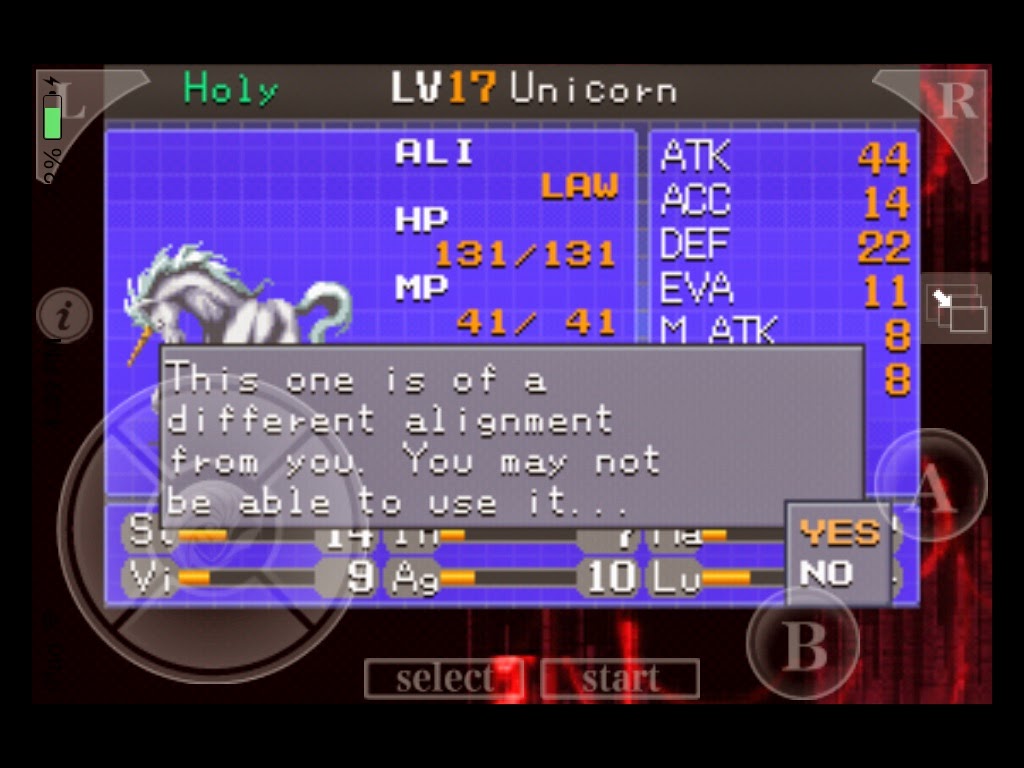
I recruit Beast Tan-ki and Fairy Gandharva, then fuse them into Holy Unicorn. Unicorn is a Strength-oriented demon with Hama and Penpatra for support and a mean Extra skill. He also reflects Expel and nulls Curse, but as Mido observes the Law-aligned demon won't be usable without shifting my alignment. He's really here as an intermediary step in the fusion process.

Holy Unicorn is fused with Night Imp to create Therian Werecat, who has no qualms about fighting alongside a boat of Marxists. Werecat comes with Hapirma (induces the Happy status on all enemies), Tarukaja and the Extra skill Feral Claw, a multitarget physical skill that lets her put that St stat to special use. Her best property is one inherent to the whole Therian race; she resists all attacks and nulls Expel.

>YES

Blue Phantom: Hey...You think the same as me.
The trick to the phantoms is that their colors are the reverse of the alignments they represent. The Blue Phantom is Chaos, the Red Phantom is Law.

>Touya obtained Headsman Axe.
Aeon Genesis translated this as the Guillotine Axe, which was a literal translation from the katakana ギロチンアクス Girochin Akusu. Their version of the Blue Phantom's line is "Let us walk the path of chaos, from which everything is born! Here, take this!"

The Headsman Axe is essentially a weapon for the Chaos Hero alone. Since our alignment matches, we can use it as well, but that really doesn't fit the hero's in-battle role as our resident item chucker.

Red Phantom: Who are you...?
The function of the phantoms is quite interesting. We can get a preview of the future forms of some characters, but only if we are of the same alignment as their respective phantoms. Is this a hint at who our future allies will be? What are the phantoms, precisely? The Diamond Realm thus far has been populated by demons and the ghosts of the past. We can speculate that the phantoms are ghosts of the future, which serve to reinforce the Law-Chaos divide of the previous chapter and prepare the player for future alignment-based confrontations, but there's little in the way of real answers as to their nature. In Japanese the phantoms are called 怪人 kaijin "mysterious persons," but phantom is a perfectly accurate translation. (As an aside, when I was doing translation work for Digimon Story Cyber Sleuth, 怪 was used in the context of a "phantom digital space.") What I think we glean from the Japanese text is that the phantoms are certainly people, but they seem to be gameplay devices that foreshadow later events for the player than they are real characters within the world of Shin Megami Tensei. This is really an issue of personal trial and growth, akin to Luke Skywalker going into the cave of evil.

The Red Phantom has three skills; Zanma, Mazanma and Diarama. So Wind is a priority issue for this fight, as is keeping up with his healing abilities. My strategy for the Red Phantom is to tuck the protagonist in back with Momunofu as a living shield, raise our attack with double Tarukajas from Momunofu and Werecat, and then use gun damage from the protagonist along with Momunofu and Werecat's physicals to mow him down while Rusalka keeps us alive with Media and Diarama. A note on the usage of Werecat, Feral Claw is slightly weaker than her base attack stat and so should only be used on multiple enemies, not against singular parties like this one. The Red Phantom gives ¥1536 and 640 MAG when defeated, as well as the Light Sword. AE specified that this was the "Kodachi of Light;" a kodachi is a type of shorter companion sword that was historically paired with a larger weapon in the same style as the wakizashi and katana. (The original text does call it Hikari no Kodachi.) Just as the Headsman Axe can only be used by someone of the Chaos alignment, the Light Sword can only be used by Law-aligned persons.

En no Ozuno: So, Touya, you have returned.
Champion: Yo. You're late.
En no Ozuno: Very good work. Take this, Touya.
>Touya obtained CRESCENT
En no Ozuno: The time has come to send you back to your world. I have unlocked the door to the east. Go when you are ready.
An important difference in translation. AGTP called the Crescent, Mikazuchi's Tachi--a tachi is a sword design that preceded the katana, pre-sixteenth century. It seems they weren't aware of how to read 三日月 which phonetically is read as mikazuki, and so Aeon's team misread it as mikazuchi and then thought they were dealing with Takemikazuchi. This is completely wrong. Mikazuki is the new moon or crescent moon phase, so rather than the sword of Takemikazuchi, what En no Ozuno handed us is the "Sword of the New/Crescent Moon." (It's also presumably a Japanese straight sword given that it's identified as a tachi.)

With Gentleman and Champion back in their party, I equip them with the Headsman Axe (+40 Attack) and Light Sword (+35 Attack +30 Accuracy.) The protagonist can't use the Crescent (+30 Attack +20 Accuracy hits one to three times), and it's questionable how much good it would do him even if he could. After all, he's really a gun-and-item character that doesn't have much business getting up close.

Goki: But you'll have to get through us first!

The most notable thing that happens to these guys is that somewhere along the line, Gentleman gets punked. This is mostly a consequence of his low HP, as while Gentleman actually has more Vi than Champion, his low St also contributes to having less hit points. Their strategy works like this; Zenki is their side's physical attacker and Goki is their magic support. Zenki has huge St and subpar Ma, but has the second-tier spell Zionga that can induce paralysis. So he can paralyze you with Zionga, then go in with the Extra skill Critical to take advantage of his own 23 St. Meanwhile Goki seals our magic with Makajama, raise Goki's attack with Tarukaja and keeps both their health up with Media.

But they only get two actions per turn, and we get six. Momunofu and Werecat quickly stack Tarukajas that cause Champion (and each other) to hit like a truck, and Gentleman aside there's no way Zenki and Goki are going to take us out while Rusalka is doing Media spam. For beating Zenki and Goki we get ¥3072 and 1280 MAG, as well as the visionary item Goki Claw. Everybody except Gentleman picks up two levels off of this, while he gets five.

En no Ozuno: You are ready. Return to your world...but do not be shocked to see how it has changed.

Touya: +4 Vi
Champion: +3 St
Gentleman: +7 Vi +1 Ma

References
Miyake, Hitoshi. Shugendō: Essays on the Structure of Japanese Folk Religion. Ann Arbor: Center for Japanese Studies, 2001.

Wednesday, August 6, 2014

Extra Chapter: Fighting Gotou and Neutral Dialogue

Before getting into the next arc there's another point to address; alternate scenes. Law and Neutral-aligned players have different objectives at this point in the game, getting a different boss fight and dialogue that we wouldn't see by siding with Gotou. We're still at the point where it's not too much of a pain for me to load my previous save and see these, so I decided to show off how things play out from a Neutral perspective.

Gotou's sitting pose seems to be based on a wax figure of Mishima that once occupied the Tokyo Tower Wax Museum. I say "seems to" because the museum was established in 1970 but some of its collection (particularly the 20th century figures) is as recent as 2001, so the figure may not have been installed until after SMT was produced.
By Tamotsu Yato in Young Samurai: Bodybuilders of Japan
There are some similar photographs of Mishima from his lifetime, like the one displayed above, that could also have conceivably been the basis for Gotou's pose. The Mishima figure itself was taken out sometime around March 2008, and I don't know if it's been reinstalled or not.

Like at the Government Office, Gotou's gimmick is that we have to make it through several waves of demons before we can fight the core boss, which wears us down over time to make the last battle more difficult. Rusalka uses Marin Karin to Charm the Nue here, which takes it completely out of commission while we focus on the Pisaca. As the Pisaca and Nue are technically in separate parties, the Nue can only attack itself while Charmed and eventually kills itself before we can. In its own way the whole idea of a spell that intoxicates you so much you'd rather die than fight the enemy is morbidly humorous.

And Rusalka doesn't even get a chance to Marin Karin as Cyak oneshots Baykok with Hama and Nekomata takes out Shade with her Extra skill.

Gotou: It seems demons are not enough to kill you. Very well, I will use my own hand.
Like Thor, Gotou has been upgraded for iOS to be immune to Charm tactics. His moveset has Shibaboo and a Diarama self-heal, but his most dangerous play is a critical hit ("uses all of his might") which deals around ~50 damage. This oneshots Cyak but not before we get off a couple Ziongas. The main problem is that he only gets one turn to our five, and even after Cyak goes down we can summon demons in its place. On-defeat he yields ¥1344, 560 MAG, -32 (Law) points and the Kotetsu. The last of these is a sword that was called the Meitou Kotetsu in Aeon's translation; it's named after Nagasone Kotetsu, a famous Edo-period swordsmith whose work was so well renowned that many forgeries submerged attempts at reliably determining the number of real Kotetsus in existence. A Meitou is a sword bearing the signature of its smith, so this would be a signed Kotetsu work, fitting for the personal weapon of a pseudo-Samurai.

While he was featured prominently in several photoshoots and videos depicting his swordsmanship, he wasn't a collector and I haven't read of Mishima owning a Kotetsu. In life his actual personal sword had a false reputation for being forged by the second Seki no Magoroku (関の孫六), also called Kanemoto II, a sixteenth century swordsmith whose line of smiths survives into the present. According to the swordmaster that sold the sword to Hiroshi Funasaka (who then gifted it to Mishima in August 1966), the sword actually originated from a shop in Yokohama, bought in the early 1960s. (Ross 220) The sword was unsigned and so not a Meitou, but its papers attributed it to a later-generation Kanemoto. Mishima's sword was thus either an unsigned Magoroku from a later generation than Kanemoto II, or it was a convincing forgery using Kanemoto's name on its paperwork. Mishima's Magoroku is said to have gone missing after it was used to decapitate him. It was also instrumental in his real coup at Camp Ichigaya--pretending to present it to the SDF commandant was the signal for his accomplices to accost and tie him up, but it was also the weapon he arranged to be used to finish himself off during his suicide. In effect, what he saw as a historical weapon would be used either to initiate the coup d'état that would reinstate the emperor, or it would be used to kill the man that tried to create that coup, giving it a lot of symbolic weight in addition to being a historical artifact. These days the whereabouts of it are unknown. The last person to handle it (in its bloody and rusted state) may have been the journalist Christopher Ross, who investigated it extensively in 2005 and was finally able to see it under certain terms of secrecy. By his own admission, what he saw may not have been the genuine article. He published comprehensive book on his investigation in 2006, Mishima's Sword: Travels in Search of a Samurai Legend, which also included a useful bibliography linking to other works on Mishima. I'd recommend it if you're interested in the novelist, as it provides a useful frame around which his beliefs and goals can be studied and makes links to a lot of the important figures in his history.

If we were on a second cycle, Gotou would drop a vision item. One of the obstacles with the whole vision system is that to really get all of the items, you have to do a minimum of four playthroughs; there are 15 items that can be acquired on a first playthrough regardless of alignment, six that can only be acquired on a second or greater cycle, two that can be gotten on a first playthrough by being Neutral-aligned, one which requires the Neutral ending, one which requires a second cycle and a (current) Neutral alignment to obtain, three which require the Chaos ending, one that requires a Chaos alignment, one that requires a second cycle and Chaos alignment with no ending requirement, three items for being Law aligned on a first playthrough, and two for having the Law ending. Since Chaos has the most items unlocked by doing the Chaos ending and Law has the most items unlocked by having the right alignment, to get all 35 vision items it's best to do the first playthrough as Chaos, the second playthrough as Law and the third as Neutral, adjusting alignment as needed to pick up the one Chaos-aligned second playthrough item. The fourth playthrough to pick up the Neutral ending item doesn't even have to be completed all the way, as that vision item shows up early on in Shinjuku. More simply organized, you can do your first playthrough according to whichever extreme sways you, do your second as the opposite alignment, and your third as the secret Neutral ending; which is appropriate, as by your third playthrough you're much more well versed in how to balance alignment and which options trigger which flags.

That's all for Gotou. My umbrage with how they handle his character in all of the routes is that unlike with Thor there's no real resolution to him. Anticlimactically he either dies a low-key death or walks out of the room, and that's that. The idea behind his character is interesting and provides a charismatic figure to lead the Ring of Gaea and the coup d'état forces, but it doesn't go anywhere in the end. Of course, Gotou is very different from the person he's based on and those differences are an interesting topic of their own. Mishima's role in assembling the Shield Society was taking what were essentially an outcast group of university students--isolated individuals whose political views did not align with the majority of the student body--and giving them an organization where their views were encouraged and accepted as a majority viewpoint. That's very different from Gotou, an SDF general who spurs people on without a specific audience to preach to. Mishima did not just create the Shield Society, but was also created by it.

As with any other dead author, studying Mishima is an all-consuming vortex, but I am not studying him for his own sake. It is not my desire to be a Mishima biographer, but to approximate why Gotou, a caricature of Mishima, is used to represent for the Chaos alignment. My belief is that the effect is to repel, rather than to attract, Japanese players. Since his suicide Mishima has been something studied in the dark, behind closed doors. He's not a part of polite conversation, or at least he wasn't during the last surge of interest around '05. His books still sell surprisingly well for a literary author, but the initial reaction in the 70s was to call him "crazy" (気違い Kichigai) and since that time his suicide has deeply overshadowed his literary achievements. (Ross 240)

I believe that part of the reasoning behind Gotou's design is because of the beliefs Mishima expressed in his fiction. In his first and most famous work, Confessions of a Mask, the protagonist Kimi-chan quotes the novelist Stefan Zweig in rejecting orthodox morality. "What we call evil is the instability inherent in all mankind which drives man [...] toward an unfathomable something, exactly as though Nature had bequeathed to our souls [...] instability from her store of ancient chaos." (Mishima 104-105) Nature's "legacy of unrest" resolves itself into "super-human and super-sensory elements," and it is this quotation leafed from Confessions to which I ascribe the namesake for Gotou's super-human Meta race. Mishima's Confessions were a fictionalized autobiography that effectively served as his coming out story, although this description fails to encompass the dark perversity of the novel and its preoccupation with homoerotic sadism, blood and cannibalism. The point is that with few limits Kimi-chan's views are Mishima's views, and that likely influenced Kaneko and Okada in choosing the basis for Gotou's character. Paraphrased Kimi-chan (and by my interpretation, Mishima) believes that "what we call evil is just a portion of the original chaos out of which man was born." (Ross 208) To live is to be in chaos, and to retreat from chaos is to be dead.

In like, Mishima was preoccupied with individuality, cultivating uniqueness and an identity separate from the masses. The character of Kimi-chan was terrified of peace, because Japan's surrender in '45 erased the certainty of death as a solution to the banality of everyday life. Suicide was only impossible during the war because the war would kill him. Confessions also provides an interesting contrast to a normalized response to art, with a scene involving Guido Reni's Martyrdom of Saint Sebastian. Where the default view of the Martyrdom would be to admire it for its spiritual qualities or impressive technique, Kimi-chan's first impulse in the novel is to masturbate. He treats a sacred work much as any other child in their first encounter with their parents' hidden pornography, in effect broaching holy iconography with homoerotic fascination, treading against a subject protected by God, and while I can only guess at this idea I believe this scene had a special influence on how Mishima was fictionalized into Gotou.

I think thus far I've given an overdramatized view of Mishima. While he had some skill in the martial arts, earnestly trained with the SDF and tried to embrace a warrior's lifestyle after the war, he never saw real combat and like his character Kimi-chan lucked out of the battlefield by coming down ill. Despite serious dedication to the craft, every witness to his actual martial ability testified to stiff wrists and a lack of mastery in kendo. He was an effete, awkward man who became a great author by essentially having nothing to live for after childhood and putting his death on hold for thirty years. Being able to do anything, he sought to do everything. And while his prose is truly important to the 20th century and he had a prescient understanding of how Japan was changing in its modernization, his real talent is often said to have been in the theater, in the realm of Kabuki and Noh drama. His first book was also his best, no matter how much he wanted the Sea of Fertility to be his greatest work. I think that in my research of him, the one thing I came to truly respect was his understanding of the nature of aging as a slow erasure of the senses, and his decision on when, where and how he would die. In the minds of everyone that knew him and in every article to be written about him, by dying at forty-five Mishima remained forty-five forever.

Gaean Priest: Although...If you give a large enough offering, I amy think about admitting you. Do you wish to offer 01000 yen to the Gaean Ashram?
At this point I need to exploit the specific feature of these healing areas, getting either +1 or -1 alignment points depending on which one you use. I have to pay the alignment fees seventeen times in total in order to shift my alignment back to Neutral after killing Gotou, which is pretty crucial seeing as I'm so Lawfully aligned at this point that it's impossible to summon Chaos demons like Cyak.

Ambassador Thorman: You have already beaten Gotou!? That...
Thor: Very good work. You have Deity Thor's praise, in the place of our Lord. Will you continue to do the Lord's work?
>NO
You will not listen to what I have to say!? Very well. I, Deity Thor, shall end your lives here!
I think that a lot of players find it confusing that a Norse deity like Thor would support the Judeo-Christian god, but there is a (possibly apocryphal) mythological basis for this. Over the course of Scandinavia's conversion to Christianity, the native Norse myths were gradually Christianized to make the invading religion more palatable to natives, with parallels being drawn between the Norse gods and figures in Christian iconography. This can be compared to the Romans equating the Greek gods with their own; Odin is treated as Yehowah, Loki is demonized into a Lucifer figure, Baldr compared with Jesus etc. So Thor was transformed gradually from one whose hammer could be used as a ward against the cross, into a figure of the newly Christianized mythology. His hammer would follow by being conflated with the cross. This irony was supplanted by the fact that participation in the Christianized myths would be his doom, as the Norse gods were eventually erased entirely along with the native paganism--Thor is reenacting his self-destruction by trying to create the Millennium Kingdom. There is a certain poetic statement to be found in the conflation of the cross/hammer iconography, as when Thor invokes his own hammer as the ICBMs this can also be read as the cross being called upon to destroy Tokyo. I would file this under Internet Knowledge though because I can't find a positive source for where the Scandinavia story originates from. You'd think it would come up in a survey of medieval art, but nope!

On a more easily overlooked note, Japanese fans have pointed out that Thor's disguise as Ambassador Thorman (トールマン Tooruman) is probably derived from President Harry S. Truman (トルーマン Toruuman) wrapping up the Shinjuku arc's World War II-centric themes. The names are one vowel mark apart in Japanese.

(This fight is unchanged except that I don't try to Charm him and instead set everyone to use guns, Zionga/Mazio and physicals and then go straight to Autobattle.)

Thor: But my hammer has been swung already. Tokyo's annihilation by ICBM is imminent. This city will perish, together with all its demons! Glory to the Millennium Kingdom!
This is the kind of dialogue that I could see lending itself to a remake. Imagine this line being read by Jamieson Price.

To close this off I'm going to address a vision item that weren't covered in the previous chapters; the Gnawed Ball from all the way back in Pascal's room in Kichijoji. You can pick it up as soon as he joins you, but this skipped my mind.

>Touya back in fifth grade...
......
Mother: I got him from Mr. Nakajima's place.
......
Mother: Oh good...It makes me glad to see you so excited over something. Remember how you were saying you wanted a pet? His name...? He said it was Pascal. That's certainly a funny name, don't you think? Try calling to him.
......
"Mr. Nakajima" is a covert reference to Akemi Nakajima, the protagonist of the Digital Devil Story novels from which the franchise was generated. It's not an actual connection though, only a tacit acknowledgement of the Megami Tensei games that preceded SMT. Nakajima's world has a completely different cosmology from most of the franchise, introduced demons to the world around 1986 and the tone of DDS was along the same lines as trashy airport novels. Having read the first novel I'm not particularly impressed with Digital Devil Story, I would compare it to the Twilight saga in quality. The novelty of intersecting magic with computer science has been put to better use elsewhere in the years since, while the actual content of the book skews towards gore matched with cheap pornography.

It's possible that the real purpose of referencing Nakajima is to cue players familiar with the novels to fuse Pascal into Cerberus, recalling Nakajima's own personal Cerberus.

Mother: (Touya was so down before, but he seems so happy now...I'm glad that I decided to go adopt that dog.)
Pascal: Arf! Woof!
Series scenario writer Ryutaro Ito once mentioned in an interview that to him, the reason we never see the protagonist's father is because his parents are split up. Pascal thus fills an important emotional void for the player character. It's a little corny, but now knowing where Pascal's fate will take him, the image of the gnawed ball is enough to evoke a sentimental feeling. Unsurprisingly, one of the driving motivations for the player up until they choose a side is to find Pascal, whose whereabouts are still up in the air. And for some players, the fact that the protagonist's dog is also a demon and an enemy of god can be sufficient reason enough to side against Thor. Would you really side with someone who wants to wipe out all of the demons when that includes one of your close friends? The Japanese transcript of this interview originates from Daisan Hinanjo "Shelter No. 3" a Japanese Megaten fansite generally held to be reputable. This is the same source which transcribed the Mega CD script, and its namesake is the protagonist's home in Megami Tensei II.

Closing thoughts; it's unfortunately rare to have genuinely learned something from a video game, but I can say for certain that I would never have read Mishima's Sword if not for SMT, nor had my interest piqued beyond a surface level on Mishima. So if nothing else, the game got me to pick up a book. On the other hand I can't say that anyone's read A Brief History of Time because of this game, but perhaps that should be next on my list.

References
Mishima, Yukio. Confessions of a Mask. Trans. Meredith Weatherby. New York: New Directions, 1958. Web. 16 July 2014.
Ross, Christopher. Mishima's Sword: Travels in Search of a Samurai Legend. Cambridge: De Capo Press, 2006.

Thursday, July 10, 2014

Translation Talk and Aeon Genesis' Modifications to Shin Megami Tensei's Script

Apologies about not getting back to this blog sooner. Between CFPro and summer semester I've been swamped, and there's a book I need to finish reading for one of the upcoming chapters. In the meantime, there's a couple topics I'd like to bridge, centering around the general issue of translation.

Let me get this out of the way: I was wrong about several points, and owe an apology for my shortcomings. It's frustrating, because this stems from one root mistake that should have been spotted well before I made my current headway into the game. It's completely counter to the whole premise of TJB, and considering how far my mistakes appear to have carried, I think that my credibility has been blown a bit out of proportion. Any readers coming over having experience with Cardfight Pro are used to me never making mistakes. As a journalist, that's pretty much in my job description. Most incorrect information never makes it into the news cycle, having been rigorously tested and verified, but Juraku is where things run more lax and that's where the room for error arises. And in the process of this, people have trusted my words too much. The core issue is that the text for Aeon's translation patch features a number of insertions that I wasn't aware of, and I mistakenly (and unfairly) criticized Atlus for omitting these. I didn't catch this sooner because there isn't a comprehensive transcript of the Japanese game text for the SNES or iOS ports of Shin Megami Tensei which made comparing text directly much more difficult than just referring to the always well-documented AE script. Accounting for the AE script being the only one that's been relevant in the west for the past twelve years, I ended up walking headlong into my own mistake.

I admit I wasn't expecting--and was definitely unprepared for--translation to become such a domineering topic. In part I owe this to the fact that I simply hadn't reconciled how wildly different some parts of each script are to one another. Between the four translations of SMT we have right now, the core events that happen in-text are the same, but the detailed dialogue, the tone of the script, the ways that characters are presented and the implications created by the presentation are drastically different. But now that those differences are apparent, it raises concerns with regards to what Shin Megami Tensei even is. When I first put down the $5 to start this up and began taking screenshots, I wasn't planning on this being a translation-centric LP, and the first time that I felt it would be a helpful discussion was when I encountered the old man in Kichijoji. It was only during the retrospective point of going back to revise before publication that I realized how integral this would be. If I didn't comment on the translation differences, somebody else was going to eventually, and so I felt it was better to approach it as an actual feature of the LP rather than just ignore it.

In the aftermath of the translation debacles of the 1990s, there's a certain paranoia in the video game community over this topic. There is a fear that somehow, just by reading a text in our own language and not in a foreign tongue, we are being implicitly lied to; that an objective truth exists in foreign languages which is not retained within our own. This paranoia has been built up on by constructed scandals, by two decades of companies like 4Kids butchering anime for the western market, by Pokémon's infamous jelly doughnuts, by Sailor Moon's dub names, by airbrushing the blood out of imported products. In the video game industry Atlus' own Revelations: Persona has acquired a legend of its own as an example of how not to translate a video game, and Nintendo's history with moralized censorship of Final Fantasy, Pokémon and Earthbound has left a strong anti-censorship sentiment within the culture. The problem with that anti-censorship sentiment is that like any anti- movement, it advocates against rather than for a cause, and in the course of advocating against, it becomes easy to lose sight of the rationale behind it. If you're anti-censorship, what is your platform outside opposing censorship? It biases the dialogue towards creating an anti-censorship versus pro-translation discussion, whereby translation implicitly advocates censorship and thus the destruction of the text.

The anti-censorship sentiment is thus easily transformed into one of anti-translation. No official translation will satisfy the community at large; only fan translations, which have the ethos of the community members ("insiders") working on them, will abate the desire for a translated video game. Fan translations acquire credibility regardless of their accuracy. Years later now I recall discussion on Persona 3's GameFAQs board over the nature of Evokers, and comments about how in the then-untranslated FES remake the Evokers were said to be powered by feathers of Nyx. At that time no one thought FES would ever make it overseas, and statements of this kind acquired a certain gravitas because they came from a version of the game we did not have, they were in a foreign language and therefore promoted an understanding we did not get from our English translation. Innately, we felt that our knowledge of Persona 3 was inferior compared to that of the Japanese players with FES. And when that remake did finally get brought over to the western market, across the board I was hearing statements about how little it improved on P3, the shoddy story and poor voice acting (with Tara Platt's Mitsuru and her faux French being a favorite target.) From my perspective there's a certain irony in comparing this to the Cardfight!! Vanguard community that I normally work in, as there's a preoccupation with the "official" story over there to the point of questioning anything that doesn't come from the mouth of a stiffly-suited corporate exec with a nametag reading "MR. BUSHIROAD."

In both cases, the problem is complacency. Either a given community refuses to believe anything written by the official publishers and only adopts information coming from fellow fans, or they become so dependent on the corporate machine as to put blind faith in the work of individuals who are ultimately at the mercy of company policy. In the pursuit of an objectively true understanding of our media, we tend to gravitate towards different forms of rejecting alternate expressions of that truth. Being a blanket moderate won't necessarily help the situation, because to answer these problematic approaches to translation you have to make an informed understanding of the different sides. Keep in mind that it is still the complacency that is at fault, not the extremism of either side. We need to be willing to question the authority of both sides of translation, not accept each of them universally and without question.

Jumping from one can of worms into another, that brings us to the issue of SMT's translation. Some clarifications on my own background with the game; I originally played SMT1 around 2008~2009 using Aeon Genesis' fan translation patch. Around this time I also became familiar with Re-Miel's translation FAQ on GameFAQs, which was more or less contemporaneous to AE and involved a more literal approach but also contained a number of flaws and presumptions that I attribute to it describing what the author was reading rather than try to create a script for insertion into a video game ROM. I ended up reading SMT1 more times than I originally intended through following a series of Let's Plays of it, which gave me a lot of time to think on it and helped spark some of my interest in Japan as a real place instead of as the weird Neverland a lot of Americans make it out to be. I began studying Japanese on my own in 2010 and (after very limited progress) started formal classes in 2012 while working on my undergraduate Asian Studies degree, and for academic reasons stopped studying in the program after my fifth semester in late 2013~early 2014. I first attempted the game in Japanese from 2012~2013, eventually lost my save data during a computer move, and since that time have referred to Japanese playthroughs on NicoNico Douga and blogsites when reading it. If two and a half years sounds like a lot of preparation, it's really not. I'm convinced you need at least four years to be good at this. I would describe the process of learning Japanese as "perpetual exhaustion," a daily repetition act that takes twice as long to learn as any of the Romance languages, and the fact that you have ~2000 written characters to learn looming over you conditions you towards the idea that no, you'll never have 'mastery,' but you can see how far you'll make it. I basically persevered until I could reliably learn things on my own and then stopped signing up for classes, the academic equivalent to turtle-shelling.

Next, the history of the script. Shin Megami Tensei's script was first written in a combination of hiragana and katakana on the Super Nintendo in 1992, phonetic Japanese scripts representing "native" and "foreign" words which are usually used in combination with kanji. This may be attributed to the SNES' limited memory, as there are around two thousand commonly used kanji but just 48 hiragana and katakana characters. (For reference, most second graders can read all of the hiragana and katakana characters, but total kanji literacy is only obtained in high school or college.) The Mega CD remake from 1995 used a revised script which incorporated kanji, and this is an important distinction because in addition to their phonetic readings kanji have innate meanings that can influence how one understands the script. The most commonly known example among Megaten fans is the word "demon," which when rendered in kanji would normally be 悪魔  "evil demon/vice spirit" but which in the games is written 仲魔 "related demon/related spirit." The writers added another layer to it by making the phonetic reading of the kanji nakama "friend" instead of akuma "demon." In English we might try to approximate that meaning as a Familiar, or in AE's case a "minion," but most commonly demons are demons. This is an example of a single word having at least four simultaneous understandings, and one of the difficulties of kanji is that it's totally possible for a skilled Japanese writer to give every word that kind of weight, although that's rarely the case. (Taking an example from some of the material we've covered on TJB, in his career as a novelist Yukio Mishima made a hobby out of using archaic kanji in his novels that publishers would have to specially request types to be cast for, as they were no longer in popular circulation and so the kanji would have to be newly molded to print his books.) The Mega CD script had some influence over the 2001 PlayStation port of the first SMT, which also used kanji, but it's not clear if the script was lifted directly or if it was rewritten from the ground up from SNES to PSX. In 2004 the fan translation group Aeon Genesis translated the SNES game, their translation became widly circulated on the internet and eventually gained exposure through multiple Let's Plays and hostings of it on YouTube. Whether AE referred to, or had knowledge of the Mega CD script is unknown, but I'm writing under the assumption that they did not. The Mega CD script is available for reference here, but any differences between it and the Japanese SNES script are not documented. The final incarnation of Aeon's script was penned by the romhacker Orden, who did so primarily to fix a number of bugs endemic to the AE patch, but also updated the script to be in line with Atlus' official translations. This version of the patch is relatively recent, released September 30 2012, and I have never played it but have seen some of it secondhand from LPs.

One aspect of this discussion that can't be restated enough is that Aeon Genesis did not just translate SMT, the group also localized it. This is a touchy subject across the board because localization is the part of the translation process where modifications, cuts and additions to the new script become an established practice. An unlocalized translation is acceptable as long as it is understandable and relates directly to the text as it appeared in its original state, but a localized translation is the point where a text stops reading like a text and starts reading like a book. A translation is readable, but a localization is fluid and written as if written by a native speaker. In the process of their localization, AE inserted a number of modifications to the script, some of which have become so memorable in the west that they have outright obscured the meaning of their Japanese equivalents. Some of these were minor, like converting Jack Lantern into Jack o' Lantern or calling Tan-ki as Tangie (which I would call a mistake because these are completely different myths), and none of AE's modifications are as drastic as those of the contemporary group DeJap (the group primarily remembered for the line "I bet Arche fucks like a tiger" a very liberal and inaccurate translation inserted into their patch for Tales of Phantasia.) But it's a fact that some major lines by key characters in AE's translation have escaped criticism when those lines are not liberal translations, but outright insertions with no resemblance to anything in the Japanese script.

The implication of this is that the Shin Megami Tensei the English-speaking world appreciates so much has never existed except as created by Aeon Genesis translations. The version of the game where Gotou accuses Thorman of setting up a dictatorship, where every other word out of Chaos Hero's mouth is "damn" and "shit," and where the old man's throat gets ripped out by a Gaki in Kichijoji mall, never existed. It would be unfair to criticize Atlus' translation for not including these things because to do so would be to create a less accurate and/or embellished translation, when even the embellishments that could be said to improve the text are not their own. It is very tempting to say that it is wrong entirely to cling to AE's translations, but with it so heavily embedded in the culture of the fandom ten years after its release, there is a greater justification at hand; that because the community of discourse established around Shin Megami Tensei has never been reading it without these embellishments, that it does not really want for a version of the game without them. The AE script sticks with the community because the non-AE script was never important to it in the first place. As someone who uses and converts Japanese to English every day I cannot approve of how the script was modified, but as a critic I can absolutely back the supporters of AE's script because it is a part of our culture.

At the same time I can't go on calling it censorship when Atlus is simply not adding in things that weren't there to begin with. In terms of practical effect and not literal methods AE did to SMT what Ted Woolsey did to FF6, making it exciting where it was mundane, visceral where it was repetitive and readable where it was not. Nobody likes Cefca and everybody loves Kefka, because "Son of a submariner!" is much better writing than "Heeeee! Kussoo!" But like Woolsey, AE also lost sight of the form of direct one-to-one authorial intent that Atlus' translation tries to preserve, even though Atlus' translation is very wooden. People love to talk about video game translation like a criminal enterprise, treating the translators as always guilty either because they're too literal or not literal enough or using honorifics or changing Engrish into Frenglish, but it's more common to have several acceptable approaches than just one true path among a sea of wrong ones.

One aspect of this many-paths approach is in the visual nature of Japanese as an ideographic system. That is to say, where kanji is being used it is possible to understand the meaning of a text by scanning the kanji printed even where pronunciation is not well understood. Because of this, it is possible to preserve the overall meaning of a sentence made into English without a 1:1 translation, much to the chagrin of more literally-minded translators. It is acceptable to rephrase a Japanese translation, because ideally perfect translations read as if the original author were fluent in the new language. There's actually an excellent example within Atlus' own history of the same lines being rewritten entirely when conveying the same meaning. Devil Survivor and its 3DS remake Devil Survivor Overclocked have entirely divergent scripts with very little being preserved in the transition between them. While Overclocked was fully voice acted and some lines were presumably rewritten to accommodate that, the game doesn't make use of extensive animation so there's no actual mouth flaps to map the dialogue to. Most famously, the Demon Summoning Program's Hello World message "Peaceful days are over_ Let's Survive" was changed to "Peaceful days died_ Let's Survive" but there's more relevant comparisons to be made, like Naoya's introductory line.
俺は「神」が苦手でね。
Ore wa "kami" ga nigate de ne.
Literal: I'm no good with God.
DS: God's no friend of mine.
Overclocked: I follow no god.
Both are faithful translations which convey his standpoint in the storyline to the viewer, but I've personally favored the Devil Survivor line. The kanji involved are 苦 "feel bitter/scowl" and 手 "hand" the latter of which is used in most words involving action, doing or skill. Nigate expresses dislike and a weakness at something, it's used similarly to the English expression "bad at/with." Just as you can be bad with math, bad with women and bad with kids, so Naoya is bad with God.

What I'm getting at is that I'm not going to call Overclocked's translation a wrong one. Certainly I disagree with it and consider Atlus' first approach better, but this line is an accurate reflection of the source material. And that's essentially what good translation is, it reflects the original script the way that the moon reflects the sun. The light that results from that reflection is weaker and visually divergent, but it comprises the same seven colors and comes from one fundamental source. Is AE a good reflection? Not particularly, as in our analogy it would be a weaker one compared to Atlus', but even weak light can be appreciated all the same. The deeper question is if we can even approach it as the same text, which I would answer with an emphatic "Yes." It's a bad translation because it's a fundamentally incorrect one, but if you can accept and have fun with the embellishments, then it's fair to say that AE made the game a lot better than it ever was in Japanese. You just have to recognize that it has little bearing on what Shin Megami Tensei actually is. Atlus' translation, while seemingly unpolished in places as with the American soldiers and occasionally wooden dialogue, is much closer to the objective understanding of SMT's script that we are trying to approach in the first place. There are minor idiosyncrasies like Gotou addressing the party as しょくん Shokkun "my friends" getting dropped from the Atlus script and kept in AE, but as a whole the Atlus script is the more accurate and honest translation.

Sure, it would be convenient if Aeon's was the one more true to the spirit of the game, but that's just not reality. It leaves some lingering questions about the accuracy of SMTII as well; I'm not as familiar with the text of the second game as I am the first, but given the two year time gap between fan translation releases, had their policy shifted at all between games? Seeing how liberal this translation is caught me off guard in part because their releases of Clock Tower, Live-A-Live, Madou Monogatari, Super Robot Wars 3, and SRW Alpha Gaiden have very strong reputations. I'm vexed to have my respect for their translations challenged when SMT if..., a game after my own heart, is one of their projects so close to completion. How will it play into all this? Most of what I've been reflecting on is over a decade old. I have not yet amended my statements in previous chapters regarding the translation, as there's a lot of them and for the time being this post follows up directly from where my mistakes left off, but I do intend to go back and revise those writings. I realize that I've only just scraped the surface of the issues presented here, but I think we still don't have a full picture of how deeply these translation differences affect SMT as a whole, and by proxy the dialogue around it. What confounds me the most is whether or not the fan translators were wrong or not in writing the script as they did.